Winter storage matters because an e-bike battery keeps changing state while the bike is parked. Cold slows the chemistry inside the lithium-ion cells, the cells lose charge on their own over time, and the battery management system can keep drawing power even when the bike is not ridden. Any of these can leave the pack depleted or stressed by the time riding resumes.
Why does winter storage matter for e-bike batteries?
Three separate mechanisms act on the battery during the months it sits unused, and each needs a different response.
| Risk | What happens to the battery | Documented guidance |
|---|---|---|
| Cold exposure | Low temperatures reduce cell performance, and charging a cold cell should be avoided | Diamant (Trek Bicycle Corporation, 2025-03-25) advises not storing below 7°C |
| Self-discharge | Cells lose charge while idle, so the level falls without any riding | Diamant (Trek Bicycle Corporation, 2025-03-25) advises recharging about every two months during long inactivity, and recharging when the charge drops below 30% |
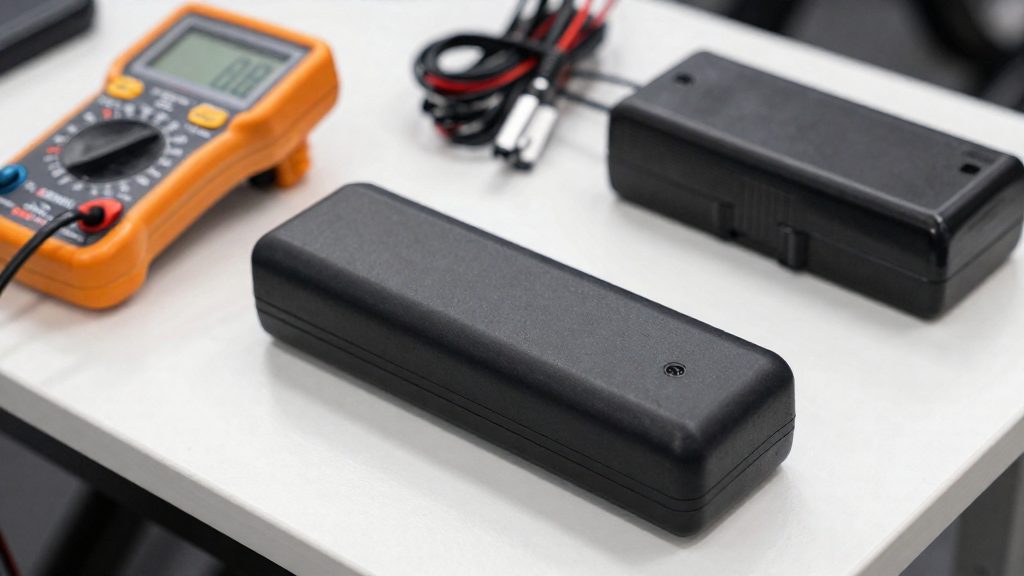
| Battery management system (BMS) standby drain | The BMS stays powered while parked and draws a small current | Check the manufacturer’s manual to see whether the battery can be disconnected or switched off |
Cold and self-discharge compound each other. A cold battery has less usable capacity, so a pack that has already lost charge through idle time has less margin before it reaches an unhealthy level. Self-discharge is slow but continuous, which means a full charge at the start of winter does not stay full. The BMS drain works differently because it depends on the bike being parked rather than on the charge level, so a battery that was full in October can still fall over several weeks if the electronics remain live.
The practical risk is deep discharge. A cell held at very low charge for a long period is stressed. The check schedule described later in this article is designed to catch the charge level before this happens, turning three slow, quiet processes into a visible number you can act on.
Where should you keep the battery?
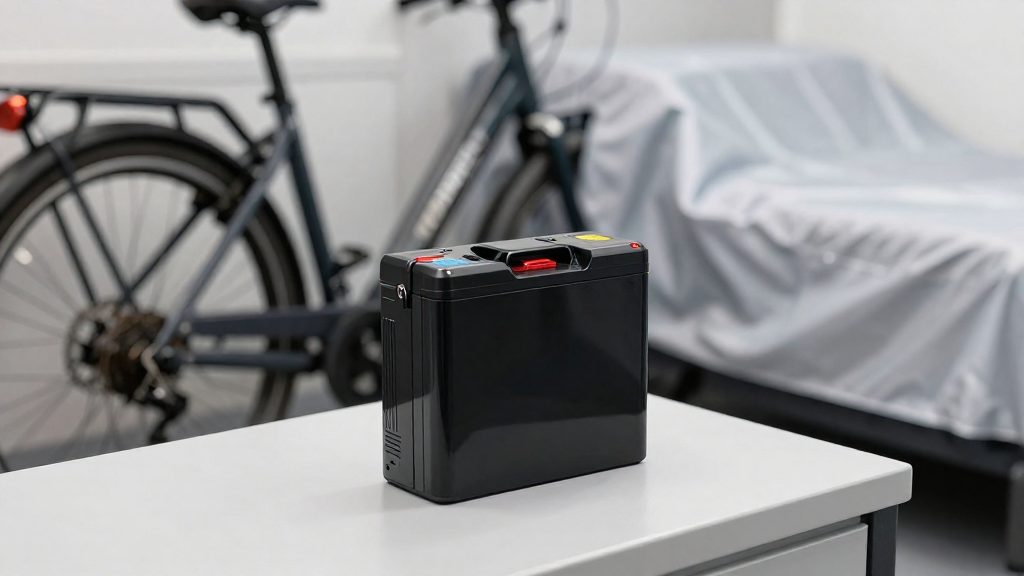
Store the battery indoors in a dry, frost-free room held within a 10–20 °C (about 50–68 °F) window, and keep it away from radiators, stoves and direct sunlight. Room choice matters as much as the thermostat setting. A garage, shed or cellar corner can drift out of range in winter even when the rest of the house is warm.
| Source | Temperature guidance |
|---|---|
| BIKE magazine (Delius Klasing, 2026-09-15) | Roughly 10–20 °C, dry, frost-free room |
| Evelo (2022-09-08) | 10–22 °C (50–72 °F), indoors |
| Diamant (Trek Bicycle Corporation, 2025-03-25) | About 10–20 °C |
The three sources agree on the 10–20 °C core. Evelo’s upper limit of 22 °C is the only value above that band, so aiming for 20 °C or below keeps the battery inside every stated range.
The 7 °C floor
Diamant also says the battery should not be kept below 7 °C. A room can be frost-free and still be too cold for storage, so do not treat “above freezing” as the target. Use a cheap thermometer placed at the actual storage spot, because a room’s reading near the thermostat may not match the corner where the battery sits. An unheated garage or shed can fall below this 7 °C floor during a cold spell.
Placement relative to heat and sun
Choose a shelf or the floor of a room with no heating appliance nearby. Avoid these positions:
- Directly on or beside a radiator, where heat can build up around the casing.
- Near a wood or multi-fuel stove.
- On a windowsill where direct sunlight falls through the day.
A simple check: if the spot feels warm to the touch in the afternoon, or sits in a sunbeam, it is too close to a heat source. Confirm with a thermometer.
What charge level is best for winter?
The sources do not agree on a single storage figure, so the correct target depends on the battery’s manufacturer. Their recommendations are:
| Source | Recommended storage charge |
|---|---|
| Bosch, as reported by BIKE magazine (Delius Klasing, 2026) | 30–60% |
| Shimano, as reported by BIKE magazine (Delius Klasing, 2026) | about 70% |
| Evelo (2022) | 60–80% |
| Diamant (2025) | about 70% |
The overlap between these figures is narrow. Bosch’s 60% upper limit touches the 60% lower limit of Evelo’s band at a single point, while the single values from Shimano and Diamant, both about 70%, sit above Bosch’s window and inside Evelo’s. No single percentage satisfies every source, so the rule is to follow the target published for your battery model.
If the manual is unavailable or the battery brand is unknown, use these two options:
- 60% sits at the top of Bosch’s range and the bottom of Evelo’s, so it is not the figure Shimano or Diamant give.
- About 70% if your bike is a Shimano-equipped model or a Diamant. This is the figure both brands give; it does not suit a Bosch battery, whose guidance is 30–60%.
Within either choice, avoid storing the battery at full charge. Evelo warns against leaving a battery fully charged for long periods.
How often should you check it?
The check interval determines how long a stored battery can sit before its charge is verified. The three manufacturer and publisher sources do not agree on a single schedule, so the table below sets out each recommendation side by side.
| Source | Recommended check interval | Stated action |
|---|---|---|
| BIKE magazine (2026) | Every one to two months | Check the stored battery’s charge level |
| Evelo (2022) | Every few months | |
| Diamant, citing Trek Bicycle Corporation (2025) | About every two months during long inactivity | Recharge when the charge drops below 30% |
The shortest interval is BIKE’s one-to-two-month check. Diamant’s is about every two months, and Evelo’s is every few months, so the more frequent schedule gives more margin against deep discharge.
Checking a battery without a charge indicator
Many older or simpler packs have no LED or display. In that case, Evelo’s method is the practical option: connect the charger and charge for about half an hour, then disconnect. Evelo suggests this as a way to keep some charge in the battery, but a half-hour charge does not tell you the actual level, so follow the manufacturer’s guidance if it differs. Record the date each time so the next check falls on schedule.
Prepare the battery and bike first
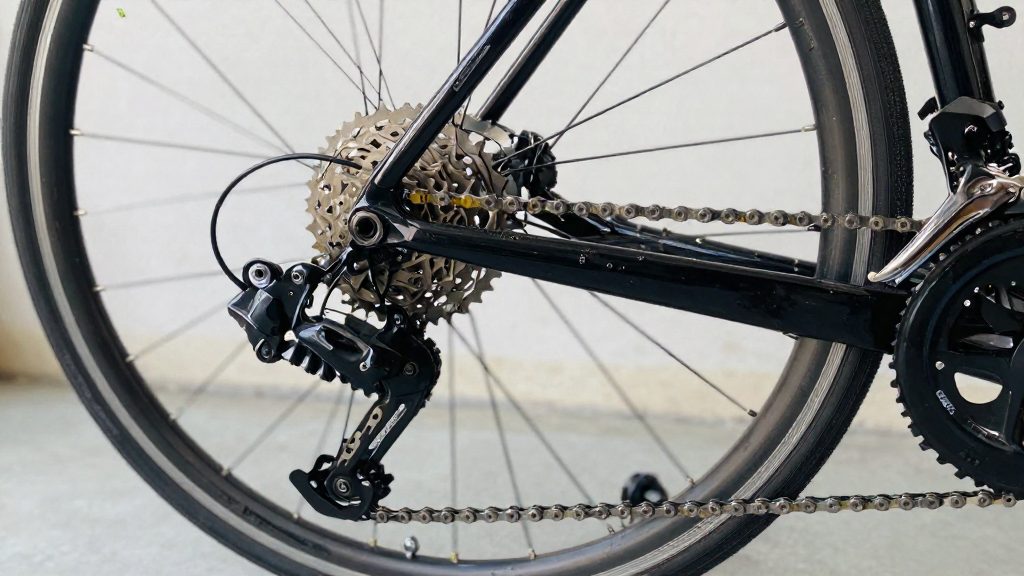
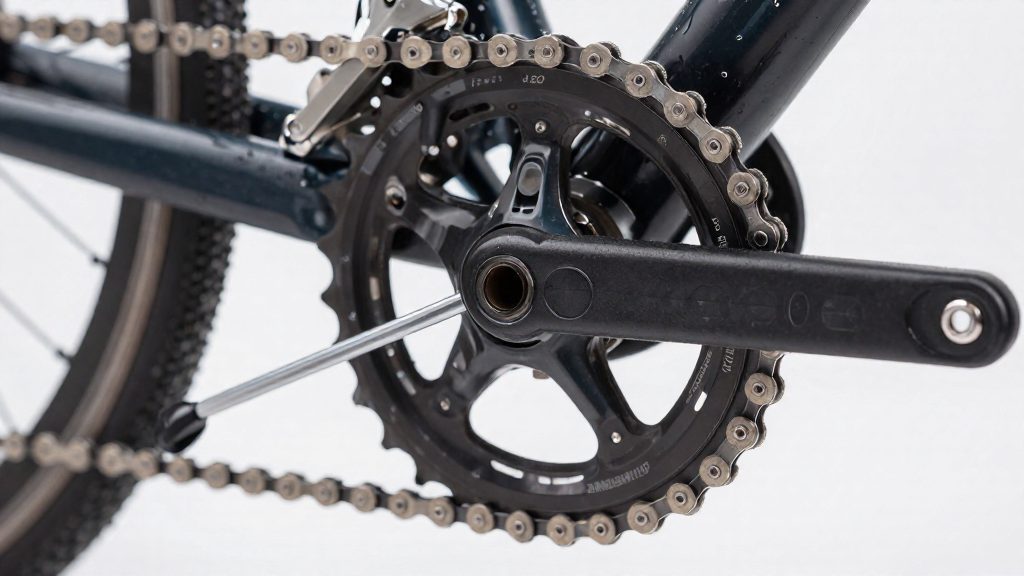
Preparation before storage follows a fixed order: clean and dry the bike, lubricate the chain, then inspect the parts that wear or misadjust over winter. Evelo, a US e-bike maker, recommends these steps before winter storage, along with checking the brakes, chain and shifting (Evelo, 2022-09-08). Doing the cleaning first means the lubricant goes onto a bare, dry chain rather than onto grime.
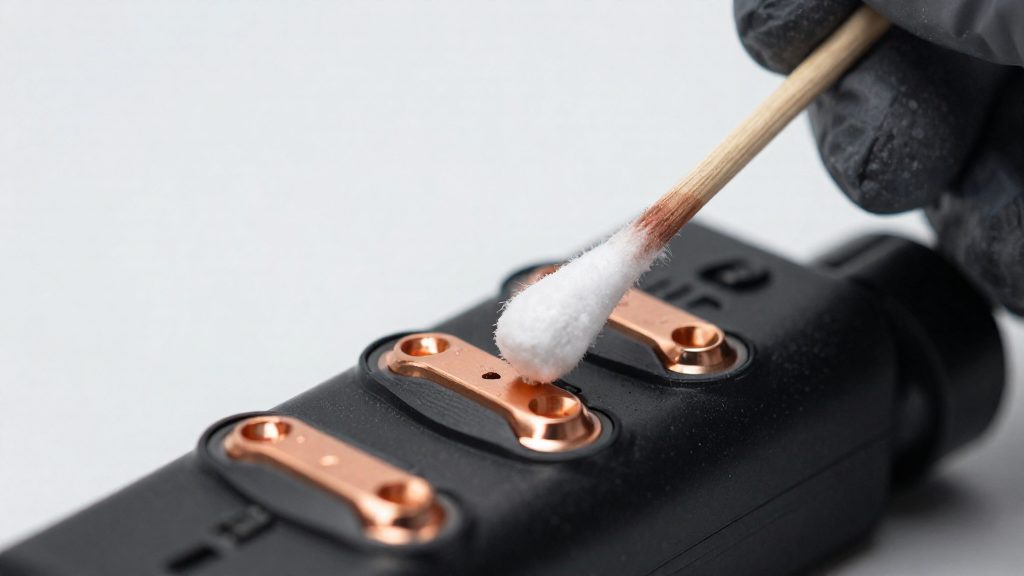
Clean and dry the drivetrain. Wipe the frame, wheels and mudguards with a damp cloth to remove road grime, then dry everything with a clean cloth. Moisture collects around the chain, cassette, chainring and derailleur pulleys, so dry those areas last. For the battery, wipe the casing and charging port with a dry or barely damp cloth, check that the port cover seats properly, and look for cracks in the casing. Avoid spraying water directly at the battery or the motor unit. Check the bike or battery manual for any removal or cleaning instructions specific to your model.
Lubricate with a bicycle-specific chain lube. Evelo advises against WD-40 and recommends a bicycle-specific chain lubricant (Evelo, 2022-09-08). Apply a thin film to each roller while turning the pedals backwards, then wipe off the excess with a clean cloth so that dirt does not stick to the surface.
Inspect before the bike goes into storage. Check the following items and address any faults before storing the bike:
| Component | What to check | Action if faulty |
|---|---|---|
| Brake pads | Pad thickness and contact with the rim or disc | Replace worn pads or re-align them before storage |
| Brake levers | Lever travel and braking feel | Adjust cable tension; if hydraulic brakes feel spongy, have them bled by a workshop |
| Chain | Stiff or stretched links | Clean and lubricate, or replace a worn chain |
| Shifting | Skipping, rubbing or missed gears across the cassette | Adjust the derailleur limit screws and cable tension |
Carry out these checks on a dry, clean bike. Problems found now are easier to fix in a workshop or at home than after a cold, wet ride in spring.
Mistakes to avoid
Three storage errors are worth avoiding over winter. Each has a different cause, and each needs its own fix.
Leaving the charger connected for long periods
A charger left plugged in keeps the battery at full charge for as long as the connection lasts. BIKE magazine (Delius Klasing, 2026-09-15) advises against leaving the charger connected for long periods, and Evelo (2022-09-08) warns against keeping the battery fully charged for long periods. Unplug the charger once charging finishes. Also check your charger’s manual to confirm whether it stops automatically, because a charger that holds the battery in a float state still counts as a long connection.
Storing the battery on bare, damp concrete floors
The sources do not single out concrete floors, but they do call for a dry room at about 10–20 °C. An unheated cellar or garage is unlikely to meet that, so keep the battery in a heated, dry room, off the floor. Store the battery off the floor on a dry, raised surface, such as a wooden shelf, and keep its contacts clean and dry before storage. Avoid storing it in a space where condensation forms on the walls or the floor.
Letting the battery run flat before storage
Starting storage with a low charge leaves little margin for self-discharge.
Evelo (2022-09-08) warns that a fully discharged battery may not revive in spring.
Waking the battery up in spring
Start with temperature. Bring the battery indoors and let it reach room temperature before connecting the charger. The sources in this review do not give a warm-up duration, so judge by touch: the casing should feel the same as the room. Charging a battery that is still cold from a garage or shed skips this step.
Then work through the recovery in this order:
- Read the charge level first. Use the charge indicator on the battery or the bike’s display.
- Charge with the manufacturer’s charger. Use the charger supplied with the battery, not a generic unit, and follow the manufacturer’s connection instructions.
- Stop if the battery does not respond. If the indicator stays dark or the battery does not take charge after one attempt, do not keep repeating the cycle. Take it to a qualified bicycle or e-bike service and ask for a battery test.
Once the battery charges normally, the first ride is the functional test. Choose a familiar route of known length, and note the charge level before and after. Compare the result with the range you recorded in earlier seasons, or with the range the manufacturer states for your assistance mode. A shortfall can come from cold weather, a lower assistance setting or a rider’s load, so repeat the test on a second ride before drawing conclusions. If the battery drains much faster than before storage, or shuts down under load, have it inspected rather than assuming the cell has recovered.
Frequently asked questions
What charge level should I leave my e-bike battery at over winter?
BIKE magazine (Delius Klasing, 2026-09-15) reports that Bosch recommends a storage charge of 30–60%, while Shimano suggests about 70%. Diamant (Trek Bicycle Corporation, 2025-03-25) and Shimano both land near 70%, which sits above the Bosch window, so check the target for your own battery model before setting the level.
How often should I check and top up a stored battery?
BIKE magazine (2026-09-15) recommends checking every one to two months. Diamant (2025-03-25) advises recharging about every two months during long inactivity and whenever the charge drops below 30%. Evelo (2022-09-08) suggests checking every few months and, if the battery has no charge indicator, charging for about half an hour at each check.
Can I leave the battery on the bike while it is parked in a garage?
Leaving the battery fitted keeps the battery management system powered, which draws a small current even when the bike is not ridden. Check whether your model can be disconnected or switched off, as described in the manufacturer’s manual. If the garage falls below 7 °C (about 45 °F), as Diamant (2025-03-25) warns, do not charge the battery until it has warmed up.