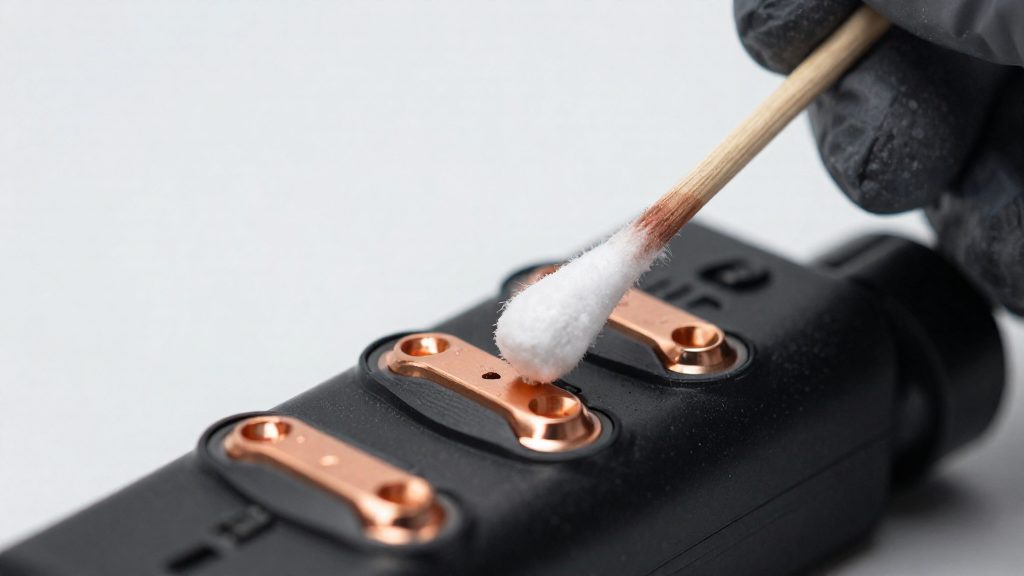
Why dirty e-bike battery contacts cause problems
Dirt, moisture and corrosion raise the electrical resistance at battery contacts. Current passes only through the metal areas where the pins and sockets touch, so any grit, residue or oxide layer between them reduces the conducting surface. Less current then reaches the motor controller while riding and less reaches the battery during charging. Because of this, contamination can cause power that cuts out or charging that fails intermittently.
| Contaminant | Effect at the contact | Typical symptom |
|---|---|---|
| Ordinary dirt and grit | Forms a non-conductive layer between pins and sockets | Power cutting out on rough terrain |
| Moisture | Collects in recesses and can start corrosion | Charging faults or the system failing to switch on |
| Corrosion | Builds an oxide layer that increases resistance at the terminals | Reduced or unstable output under load |
The contacts sit inside recesses in the battery mount and housing, where water and grit collect and dry slowly.
A partly corroded contact may conduct only when the battery is seated at a particular angle or when vibration shifts the connection. This is why a fault can appear and disappear on bumpy roads yet be absent when the bike is stationary.
What do you need to clean e-bike battery contacts?
Cleaning e-bike battery contacts requires three basic items: soft dry cloths, a small soft brush, and protective caps or fabric for the ports and connections. A low-pressure water source is needed only if you also wash the bike, and it should never be aimed at the contacts. These tools suit the job because the goal is to remove ordinary dust and moisture, not to treat heavy corrosion.
| Item | Role in the job | Source |
|---|---|---|
| Soft, dry cloth | Wipes the contacts once the bike is completely dry, and clears dirt and moisture before reinstalling | Finish Line USA (2025); Wintersteiger (2025) |
| Small soft brush | Reaches recessed areas without forcing bristles into delicate contacts | Upway (2025) |
| Protective cap or fabric | Covers the display, charging ports and electrical connections before washing | Finish Line USA (2025); Wintersteiger (2025) |
| Low-pressure water source | Rinses the bike; low pressure is the only water pressure recommended | Finish Line USA (2025); Upway (2025) |
How do you clean e-bike battery contacts step by step?
Cleaning battery contacts safely depends on the order of the work. The system must be off, the battery separated from the frame where possible, and the contacts fully dry before any electrical connection is made. Following the same sequence each time reduces the risk of moisture being trapped in the battery mount or the connections.
-
Power down and remove the battery. Switch the e-bike completely off. If the battery is detachable, remove it from the frame before touching the contacts or washing the bike. According to Finish Line USA (2025), the display, charging ports and electrical connections should be covered with a clean, dry cloth or protective cap before any washing begins. If the battery is detachable, remove it from the frame before touching the contacts. According to Finish Line USA (2025), the display, charging ports and electrical connections should be covered with a clean, dry cloth or protective cap before any washing begins.
-
Wash the rest of the bike at low pressure, if needed. Finish Line USA (2025) recommends a low-pressure rinse only. Keep the battery off the bike and the ports and connections covered, and do not aim water at the contacts or connectors.
-
Wipe with a soft, dry cloth. Remove visible dirt from the contact area with a soft cloth. Use a small soft brush for recessed areas, without forcing the bristles into delicate contacts. Wipe in one direction, and replace the cloth once it becomes grubby, so that grit is not dragged back across the pins.
-
Allow complete drying. Leave the battery and the connection area to air-dry until no moisture is visible. Upway (2025) states that the connection must dry completely before the battery is reinstalled, the bike is switched on, or charging begins. This is the stage where most electrical faults caused by cleaning are avoided.
-
Final dry wipe and reinstallation. Immediately before reinstalling, Wintersteiger (2025) recommends clearing any remaining dirt and moisture from the contacts with a dry, clean cloth. Seat the battery fully, then switch on or charge only after this check is complete.
Is isopropyl alcohol or contact cleaner safe to use?
A contact cleaner is acceptable on e-bike battery terminals only when two conditions are met: it is made specifically for electrical contacts, and it is approved for your particular e-bike system. Upway (2025) states this rule directly, and it applies whatever the product’s name or appearance. A cleaner that is marketed as a general-purpose spray does not meet it.
Isopropyl alcohol follows the same test. Use it on battery contacts only if its label says it is suitable for electrical contacts and for your system. If the label is silent on either point, treat the product as unapproved and do not use it on the terminals.
System approval is the step most often skipped. Battery and drive systems differ between manufacturers, and a product that suits one system may not be approved for another. To confirm approval, read the e-bike’s owner manual or the battery maintenance section, then check the wording on the cleaner’s label against it. If the manual gives no cleaning guidance, contact the bike manufacturer or your local authorized dealer before using any product on the contacts.
| Product | Use on battery terminals? | Condition |
|---|---|---|
| Electrical contact cleaner | Yes | Made for electrical contacts and approved for your e-bike system |
| Isopropyl alcohol | Only if labelled | Label names electrical contacts and your system |
| Any unlabelled or general-purpose spray | No | Listed among products to avoid on contacts |
Approval is the deciding factor. Two products can look alike on a shelf, yet only one may carry the wording your system requires. Compare the label text, not the product name, and keep the cleaner’s packaging with your maintenance records so you can confirm the approval later.
What should you never use on battery terminals?
Three groups of products and tools damage e-bike battery contacts or the components around them: general-purpose cleaners, abrasives, and high-pressure water. Each one attacks the contact surface, its connectors, or the seals around the electrical area, so none of them is a shortcut for cleaning.
Household cleaners are the most common mistake. Upway (2025) lists household cleaners, chain degreaser, vinegar, baking soda and general sprays among the products to avoid on contacts. Chain degreaser is the one most often reached for because it is already in the workshop, but it is made for drivetrain parts, not for the electrical surfaces of a battery.
Abrasives remove material as well as dirt. Upway (2025) advises against sandpaper, files and metal brushes on small contacts. Their coarse action is hard to control on small metal pads, so they can alter the surface you are trying to clean.
High-pressure washers are the third risk. Wintersteiger (2025) says to avoid high-pressure cleaners when washing an e-bike.
Should you grease the contacts afterward?
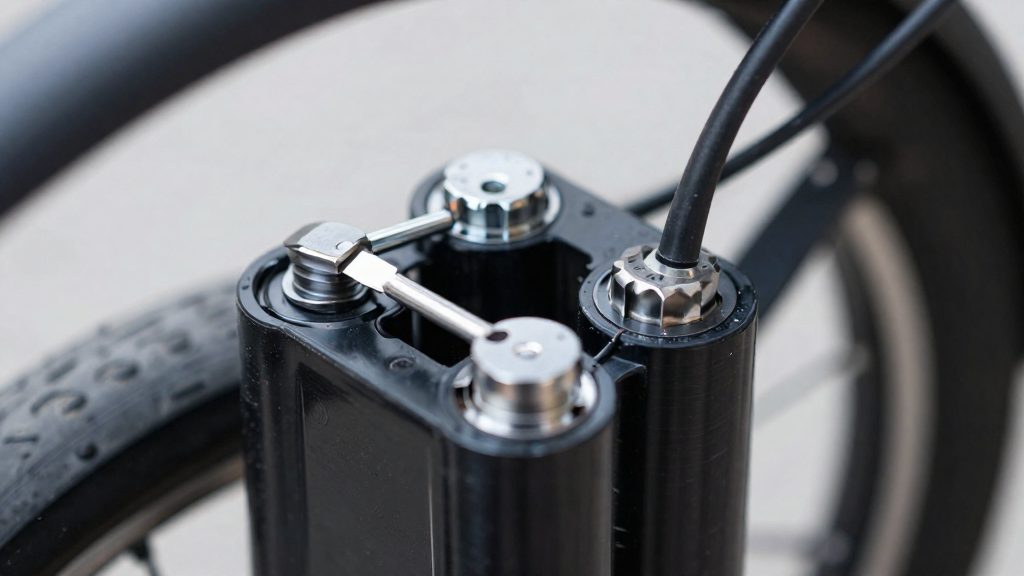
Greasing is not a default step after cleaning. According to Upway (2025), dielectric grease should be used only where the manufacturer recommends it, so the first check is the instructions for your specific e-bike or battery. If the manufacturer names grease for the contacts, apply it only to the contacts they specify. If no grease is recommended, the contacts stay uncoated.
Contact spray is treated as an optional extra. Wintersteiger (2025) states that contact spray can add protection if needed, which makes it a judgement call rather than a required product. Use it only when you want that additional layer and the product is suitable for electrical contacts.
The three possible situations, and the action for each, are:
| Manufacturer guidance | Action after cleaning | Source |
|---|---|---|
| Dielectric grease specified | Apply grease only to the contacts named in the guidance | Upway (2025) |
| No grease specified, extra protection wanted | Optional contact spray, only if it is made for electrical contacts and approved for your e-bike system | Wintersteiger (2025) |
| No grease specified | Leave the contacts bare, with no added coating | Upway (2025) |
The table reflects the logic of the sources: grease depends on manufacturer approval, while spray is a discretionary addition. Neither product replaces cleaning. Applying either to dirty or wet contacts defeats the purpose, so the contacts must already be clean and dry before you decide.
How often should you check battery contacts?
Check the contacts based on riding conditions rather than a fixed calendar: after every wet or muddy ride, and again before the bike goes into seasonal storage. Battery contacts sit where water, grit and road spray collect, so exposure depends more on where you ride than on how many miles you cover. A quick visual check after each exposed ride shows you whether a surface film is building up, which lets you act before it becomes a larger problem.
Inspect after every wet or muddy ride
Once the bike is dry, look at the contacts with the battery removed if it is detachable. The post-ride inspection is where you confirm that no moisture or grit reached the mount.
Light dust versus corrosion: a visual check
Compare what you see against the table below.
| Observation | Likely condition | Next step |
|---|---|---|
| Fine, loose film that comes off with a dry cloth | Light dust | Remove ordinary dirt with a soft cloth |
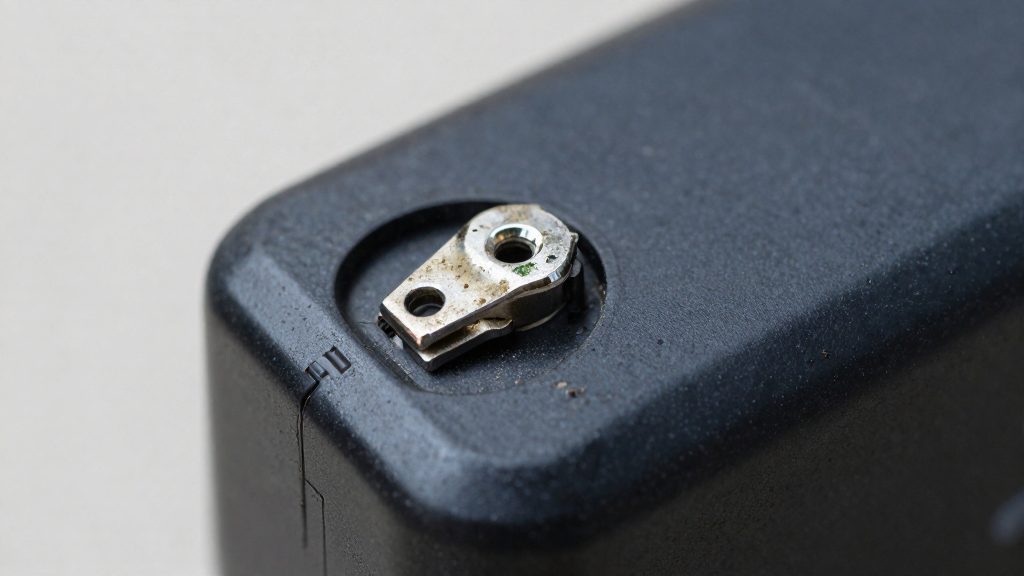
| Residue that remains after wiping, or discoloured or pitted metal | Possible corrosion or damage | Assess for repair rather than cleaning |
Check the surface in good light and look into the recessed areas around each contact, since dust tends to collect there first.
Inspect before seasonal storage
Inspect the contacts before the bike is put away for a season. A residue that you missed after the last ride is easier to identify when the contacts are still accessible and the bike has not been idle for months. If the check reveals residue that does not come off with a dry cloth, arrange a repair assessment before storage rather than leaving the contacts unaddressed over the off-season. Recording what you found at each check also gives you a baseline to compare against at the next inspection.
When to see a shop
Some battery contact problems cannot be solved at home. According to Upway (2025), corrosion or damage may need repair rather than cleaning. If the contacts still look discoloured or pitted once the bike is fully dry, the metal may have been affected beyond what cleaning can reverse, so have a technician assess it. Physical damage works the same way. A bent, cracked or loose contact needs a technician to assess and replace or repair the part.
Persistent faults are the second case. If the battery still will not power the system, charge, or register on the display after you have cleaned the connection and let it dry completely, stop using it and take it to a service for diagnosis. A fault that returns after the contacts have been cleaned and dried may have another cause, such as the battery, its mount or the controller, so have it diagnosed rather than assuming the contacts are fine.
| Condition | Action |
|---|---|
| Corrosion or physical damage on contacts | Repair by a technician |
| Fault remains after thorough cleaning and drying | Battery diagnosis at a service |
Finding an authorised local service
For battery diagnosis, choose a shop that works on your bike’s system rather than a general repair counter. Check the battery label or the manufacturer’s instructions for the name of the authorized service network, then contact the nearest listed workshop. Before you go, note the battery model and the bike’s make and model, so the technician can identify the correct diagnostic procedure. Ask whether the shop tests the battery itself and whether it can reset or update the battery management system, since these checks cannot be done with a standard bike tool kit.
Frequently asked questions
Can I use dielectric grease or contact cleaner on e-bike battery contacts?
Use dielectric grease only where the manufacturer recommends it. A contact cleaner is acceptable only if it is made for electrical contacts and approved for your specific e-bike system.
How often should I clean e-bike battery contacts?
There is no fixed schedule. Check and clean them when you see grit or moisture, especially after wet or muddy rides, and before storing the bike through winter.
Can I use a pressure washer or hose on the area around the battery?
No. Keep high-pressure cleaners away from the battery mount, controller, display and charging port. If you wash the bike, remove the battery first and cover the contacts with fabric.