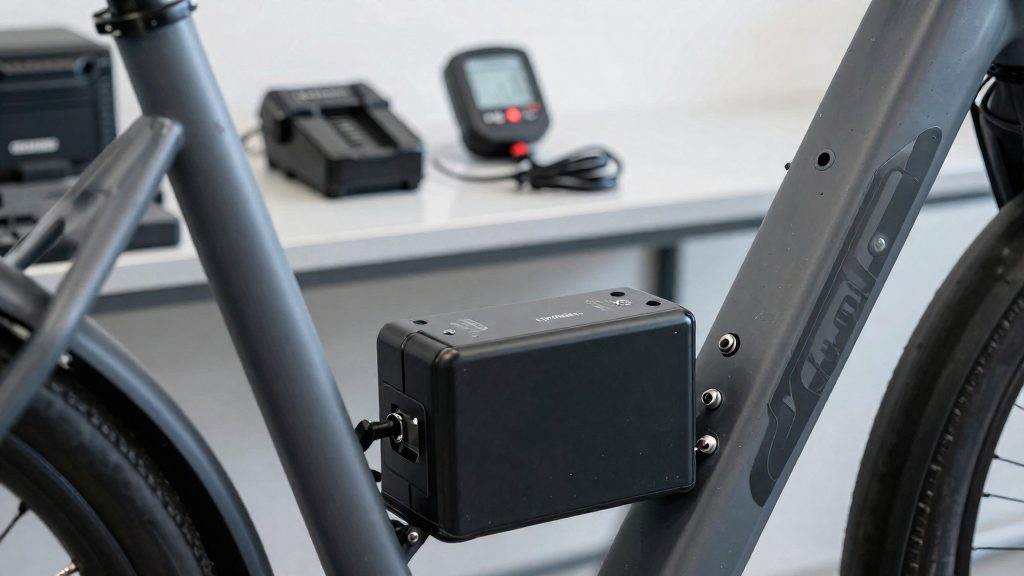
Charging a cold e-bike battery is risky because cold charging can permanently damage the battery cells (Rize Bikes, 2026). Cold also raises electrical resistance, which makes charging slower (Cycling UK, 2026). The cause sits inside the cells, where lithium ions must move from the positive electrode into the graphite of the negative electrode (the anode) during every charge.
Why is charging a cold e-bike battery risky?
Lithium plating on the anode
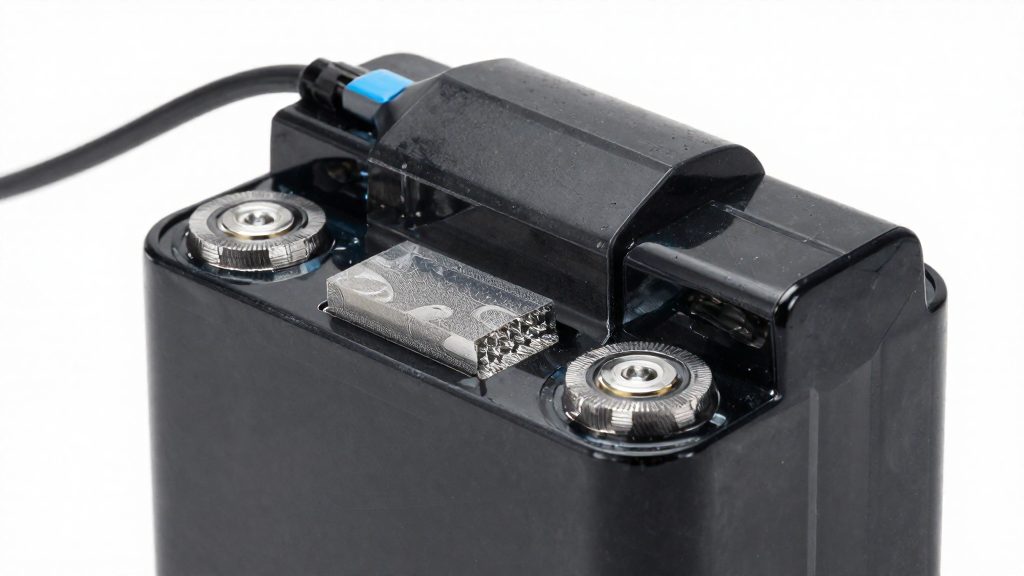
Charging drives lithium ions into the layered graphite structure of the anode. Cold slows this movement because the electrolyte becomes more viscous and ions diffuse more slowly. If ions reach the anode faster than the graphite can accept them, some are deposited as metallic lithium on the anode surface. This process is called lithium plating. Plated lithium is no longer part of the active material that stores charge, so it reduces usable capacity. Deposits can also grow into needle-like structures that may damage the separator between the electrodes.
Higher internal resistance and heat
Lower temperature reduces ion mobility throughout the electrolyte, which increases the cell’s internal resistance. The effects appear during charging:
| Effect at low temperature | Consequence during charging |
|---|---|
| Ions move more slowly | Charging takes longer |
| Resistance rises | Energy is lost as heat inside the cell |
| Ions arrive faster than the anode accepts | Lithium plating forms on the anode |
The outside of the battery is not a reliable guide to the temperature of the cells, so do not judge by touch whether it is safe to charge.
Why the damage is irreversible
Plated lithium partly reacts with the electrolyte, which thickens the protective layer on the anode surface. These changes do not reverse when the battery warms later, so the irreversible capacity loss remains. Each cold charge can add to the total. The battery may still charge and ride normally after the event, while its usable capacity has fallen for good.
What temperature is safe for charging?
Charging is the step where cold causes lasting harm. Eurorad (2026) advises against charging when the battery is below about 10°C. Riding in the cold is a different question, with different limits.
| Temperature | Effect on the battery | Source |
|---|---|---|
| Below about 10°C | Do not charge | Eurorad (2026) |
| 5°C and below | Loss of efficiency and capacity | Cycling UK (2026) |
| Below freezing | Power can drop by up to one-third | Cycling UK (2026) |
The three thresholds describe different risks. The charging threshold of about 10°C is the one that protects the cells. The capacity loss at 5°C and below affects how far you can ride, but Cycling UK (2026) states that riding in the cold does not damage the battery. The power drop below freezing is more noticeable on hills and during acceleration, and it reverses as the battery warms.
In practice, treat 10°C as the point below which you do not plug in the charger. A battery that has just come off a cold ride may still be below that point even if the air around the bike feels mild, so do not assume it is safe to charge right away. If you cannot confirm the battery is above 10°C, wait before connecting the charger.
How long should the battery warm up first?
After a cold ride, leave the battery indoors for at least two hours before connecting the charger. Cycling UK (2026) recommends a couple of hours, and Eurorad (2026) specifies at least two hours at room temperature.
Warm-up at room temperature
Warming should happen at normal indoor temperature with no added heat. Remove the battery from the bike, keep it in a dry room, and leave it alone until it has reached room temperature. Rize Bikes (2026) advises bringing the battery indoors straight after the ride, so the warm-up period starts as soon as you get home.
Why external heat should be avoided
Cycling UK (2026) advises against speeding up warming with a heater. The guidance is to let the battery warm on its own.
Timing relative to the end of the ride
| Stage | Action | Source |
|---|---|---|
| Immediately after the ride | Bring the battery indoors and keep it off the charger | Rize Bikes (2026) |
| First two hours indoors | Let the battery reach room temperature without added heat | Cycling UK (2026) |
| Two hours or more later | Connect the charger once the battery is at room temperature | Eurorad (2026) |
Where to charge at home
Charge your e-bike battery in a warm, dry room, not in an unheated garage, shed or porch. According to Cycling UK (2026), charging should only happen in a warm, dry room because cold raises electrical resistance, which makes charging take longer and can cause damage. The room you choose matters as much as the charger itself.
What makes a room suitable
A suitable room is heated and stays dry year-round. Warmth alone is not enough: the room must also be dry.
| Location | Suitability | Reason |
|---|---|---|
| Heated, dry living room, utility room or hallway | Suitable | Meets the warm, dry requirement (Cycling UK, 2026) |
| Unheated garage or shed | Unsuitable | Cold raises electrical resistance (Cycling UK, 2026) |
| Damp space near water or condensation | Unsuitable | Fails the dry requirement (Cycling UK, 2026) |
Why unheated garages and sheds fail
Garages and sheds are often unheated, so charging there exposes the battery to cold. Rize Bikes (2026) warns that cold charging can permanently damage the battery cells. A battery brought in from a cold garage is still cold inside, so plugging it in there exposes the cells to the same risk. Choose a warm, dry indoor room for charging and storing the battery.
Keeping the charger away from moisture
Place the charger on a dry, raised surface, away from sinks, taps and wet floors. Before connecting, check the battery port and the charger plug for water or condensation, and wipe them dry if needed. Condensation often forms when a cold battery is brought into a warm room, so inspect the connection once the battery has reached indoor temperature rather than immediately after coming in.
How do you charge safely after a winter ride?
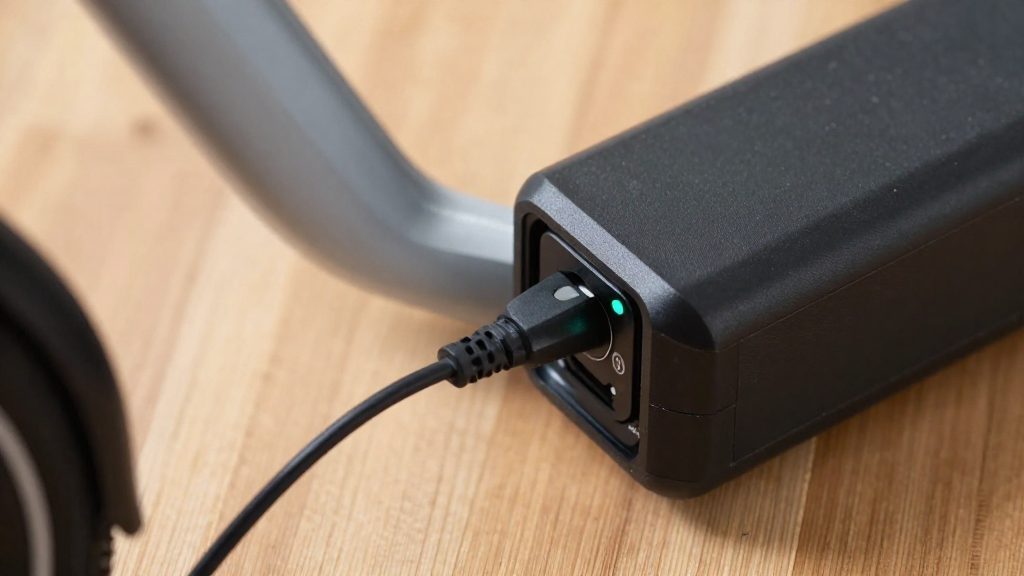
Winter charging starts before the charger goes in. After a ride, take the battery off the frame, carry it indoors, and check the charge port for water, grit, and road salt. Rize Bikes (2026) recommends bringing the battery indoors after a ride, and the steps below cover what to do once it is inside. Moisture and salt that reach the electrical contacts can cause corrosion and faults.
| Step | Action | Purpose |
|---|---|---|
| 1 | Switch off and remove the battery from the frame | Lets you carry the pack indoors and handle it away from wet frame surfaces |
| 2 | Carry it indoors upright and keep it dry | Keeps snow, meltwater, and road grime off the housing and port |
| 3 | Wipe the charge port and contact pins | Removes salt and grit before they can corrode metal or conduct between pins |
| 4 | Inspect the rubber port cover and seal | Confirms the port is still sealed against moisture |
Road salt is the main hazard on winter routes. Salty water conducts electricity, and residue left on metal pins can corrode them over time. Use a dry cloth to remove loose grit first. Then use a soft brush or a cloth lightly dampened with water to clear salt from the contact pins, and dry the area completely before reconnecting. Clean only the outside of the port. Do not let liquid run into the connector.
To check the charge port, look at the rubber cover and its seal. Look for cracks, torn edges, or a cover that no longer sits flat. Look inside for green or white crust, bent or discoloured pins, and any trace of moisture. If you find corrosion, a bent pin, or water inside the port, do not charge the battery. Contact the battery supplier or an authorised service centre for the e-bike model before using it again.
Reseal the port after every wet ride, even if it looks clean. A loose or missing cover lets meltwater and salt spray in during the next ride, so replace a damaged cover before the next outing.
How should you store the battery over winter?
Winter storage depends on two variables: the temperature the battery sits at and the charge level it holds while idle. According to Cycling UK (2026), the battery should be kept indoors at 5–20°C in a dry room. Cycling UK (2026) recommends keeping the battery indoors at 5–20°C in a dry room, and Rize Bikes (2026) advises storing it indoors at the latest when temperatures fall below 0°C. Since 5°C is the lower end of the recommended range, have the indoor storage spot ready before the first hard frost and bring the battery in before it gets that cold.
| Storage parameter | Guideline | Source |
|---|---|---|
| Location | Indoors, dry room | Cycling UK (2026) |
| Temperature range | 5–20°C | Cycling UK (2026) |
| When to bring indoors | When temperatures fall below 0°C | Rize Bikes (2026) |
| Charge level for idle periods over one month | Roughly 60–80%, not 100% | Cycling UK (2026) |
The 60–80% charge band applies only to idle periods longer than one month. Check the charge indicator before the battery goes into storage, and adjust it into the band if the break is expected to exceed a month.
Keeping the battery in the 5–20°C range also limits the performance loss that cold causes. Cycling UK (2026) notes that below 5°C the battery loses efficiency and capacity, which means a battery stored in a cold garage or shed may not deliver its full range when the riding season returns. Storing it indoors within the recommended range avoids that loss without requiring any special equipment.
Mistakes to avoid in winter charging
Winter charging damage can come from connecting a battery that is still cold, wet or showing a fault. The charging stage is where these errors do the most harm.
Plugging in a battery with condensation or frost
Moving a battery from an unheated garage or from outdoors into a warm room leaves moisture on the casing. Frost is a strong warning sign that the battery is cold, but the absence of frost does not show it is safe to charge. Wait until it has reached room temperature. Eurorad (2026) states that the battery should not be charged below about 10°C. Connecting the charger to a battery with frost on it skips that check.
Charging while the display shows fault codes
A fault code means the battery or the bike’s electronics have flagged a condition that needs attention. Repeatedly reconnecting the charger to clear the message does not identify the cause, and charging a flagged battery can add stress to a component that may already be compromised. Look up the code in the manufacturer’s manual, which is included with the bike or available from the manufacturer’s website. If the code is not explained there, or it persists after the battery has reached room temperature, take the bike to an authorised dealer for diagnosis.
Charging unattended on a timer overnight
Timers and smart plugs that start a charge in the middle of the night are a common cause of unnoticed problems. A timer may begin charging while the battery is still cold, and no one is present to see a fault code, a warm casing or a charger that has stopped working. Do not leave the battery charging unattended or overnight. Stay nearby while it charges, and follow the charger’s and battery’s manuals.
What does your manufacturer’s manual say?
The manual that came with your bike is the reference for your specific battery and charger. General guidance sets a baseline, but where the manual states a limit for your model, that limit takes precedence.
Battery and charger identification comes first. Note the battery and charger model numbers from their labels and match them against the compatibility section of the manual. Charge only with the charger the manufacturer specifies for that battery. If neither the label nor the manual names a compatible charger, contact the manufacturer or your retailer before connecting anything.
| Item to check | Where to find it | What it tells you |
|---|---|---|
| Operating and charging temperature range | Battery or charging section of the manual | The limits your battery is rated for |
| Charger output rating | Charger label and manual specifications | Whether it matches the battery’s stated input |
| Warning and fault codes | Display or controller section of the manual | What each icon or code means for your system |
Fault indicators on the display are specific to each system, so read the manual’s table rather than relying on a generic guide. If the display shows a battery or charging fault, stop charging, look up the code, and contact the relevant service if it returns. Repeatedly reconnecting the charger can prolong the fault.
Where the manual is silent on temperature, apply the general guidance from Cycling UK (2026) and Rize Bikes (2026). Where it gives a figure, follow the manual, since the manufacturer designed the battery and charger as a pair.
Frequently asked questions
Can I charge the battery as soon as I get home from a cold ride?
No. Eurorad (2026) advises against charging below about 10°C, so bring the battery indoors and let it reach room temperature first, for at least two hours. Plugging in while the housing is still cold, or while frost is on it, skips that check.
Does riding in cold weather damage an e-bike battery?
Cycling UK (2026) states that riding in the cold does not damage the battery. Below 5°C it loses efficiency and capacity, and below freezing its power output can drop by up to one-third, so expect shorter range on cold rides.
Where should I store the battery during a winter break?
Keep it indoors in a dry room at 5–20°C, the range Cycling UK (2026) recommends. Rize Bikes (2026) sets 0°C as the latest point to bring the battery inside, so move it before temperatures reach that level. If it will sit unused for more than a month, Cycling UK suggests a storage charge of roughly 60–80% rather than full, or following the manufacturer’s manual.