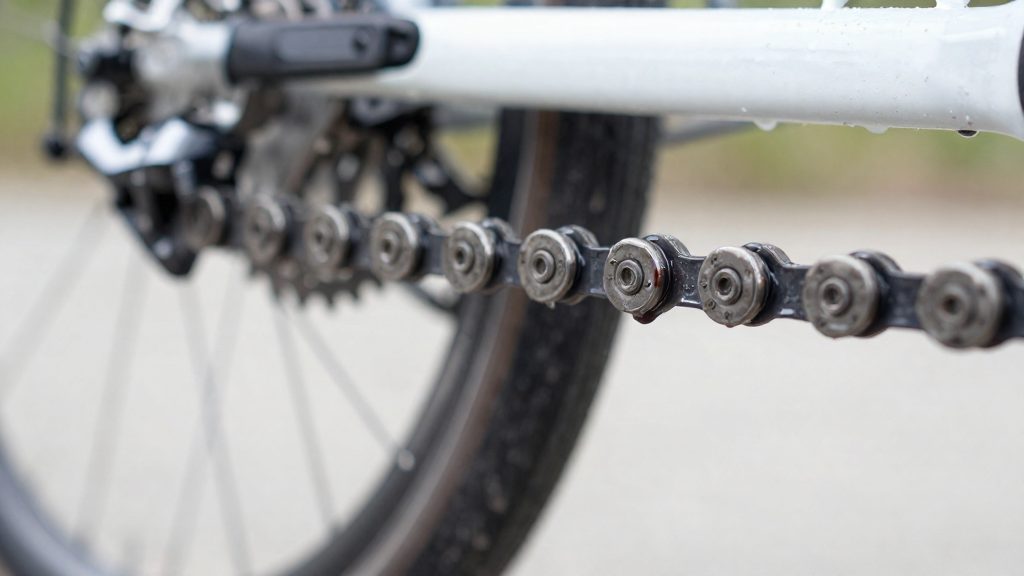
Wet and dry chain lubes differ mainly in viscosity, in how the carrier behaves once applied, and in how the resulting film handles water. According to road.cc (2025), wet lube is designed for wet and rainy conditions. Dry lube dries to a film, which keeps the chain cleaner. The choice therefore depends on whether the priority is wet-weather resistance or a cleaner drivetrain.
Wet lube vs dry lube: what’s the difference?
Viscosity and flow
Wet lube formulas have a thick, slow-flowing consistency. Because they remain liquid on the chain, they stay in the rollers and between the link plates rather than running off the chain as the bike is ridden in rain or spray.
Drying behaviour and film
Dry lube carrier evaporates and leaves a dry film on the chain. This film is the reason dry lube stays cleaner, since it holds less of the road grime that collects on a tacky, wet film. The trade-off is durability: dry lube can wash off in wet conditions, and road.cc (2025) notes that it needs more frequent reapplication than wet lube.
Water repellency and rust protection
Wet lube formulas repel water and help prevent rust. These two properties matter most when a chain is repeatedly exposed to moisture, which is the situation dry lube’s film is least suited to. For dry riding, the cleaner film of dry lube is the practical advantage; for rain, the water-repellent, liquid film of wet lube is the one that holds up.
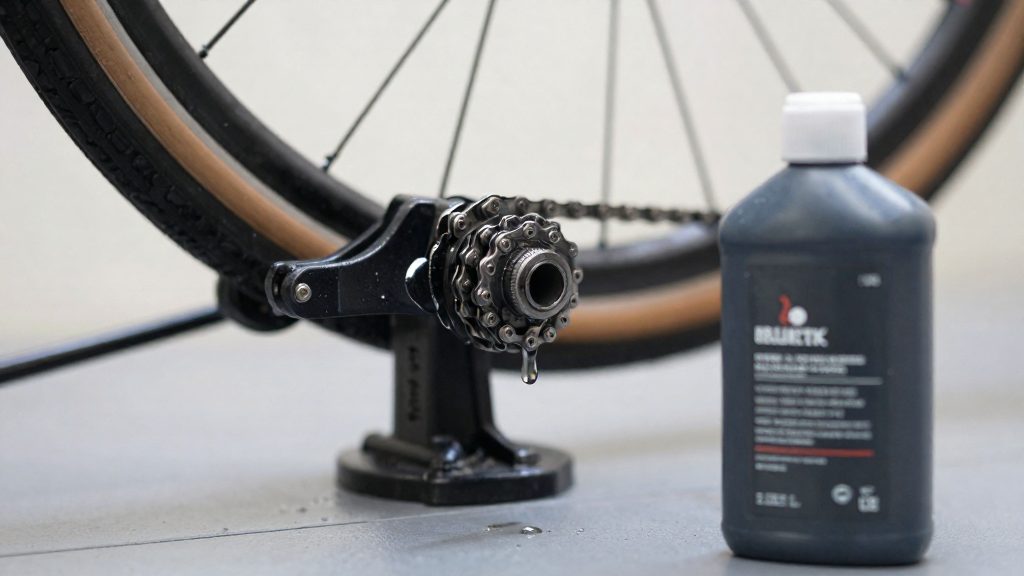
What is the best bike lube for wet weather?
Road.cc lists Green Oil Wet, Peaty’s LinkLube Wet Weather, Fenwicks Wet Weather and Wolf Tooth WT-1 as wet-weather picks, and BikePerfect names Peaty’s Link Lube Wet best for wet-weather protection. Wet lube is the category recommended for rainy rides.
| Product | Publisher (year) | Stated positioning |
|---|---|---|
| Peaty’s LinkLube Wet Weather | road.cc (2025) | Listed as a wet-weather pick |
| Peaty’s Link Lube Wet | BikePerfect (2024) | Named best for wet-weather protection |
| Silca Synergetic Wet Lube | BikePerfect (2024) | Performs well in both wet and dry conditions |
Peaty’s LinkLube Wet Weather appears in road.cc’s wet-weather selection, which also includes Green Oil Wet, Fenwicks Wet Weather and Wolf Tooth WT-1. BikePerfect’s top pick for wet-weather protection is Peaty’s Link Lube Wet. The two Peaty’s names differ slightly, so check the bottle label to confirm which formulation you are buying before comparing them.
BikePerfect says Silca Synergetic Wet Lube performs well in both wet and dry conditions, which makes it a candidate if your chain sees both rain and dry roads. BikePerfect also names Peaty’s Link Lube Premium All Weather as best overall.
For a chain that will face sustained rain, a wet formula suits better than a dry one. BikePerfect names Peaty’s Link Lube Wet best for wet-weather protection, while road.cc lists Peaty’s LinkLube Wet Weather among its wet-weather picks. Silca Synergetic Wet Lube is a candidate when you ride in mixed conditions, according to BikePerfect.
Why do dry lubes fail in the rain?
A dry lube dries to a film on the chain. According to road.cc (2025), dry lubes can wash off in wet conditions. Rain and road spray strike the chain continuously, and the film gradually lifts off the metal. The protection a dry lube gives on a dry ride cannot be assumed in rain.
Once the film is displaced, the pins are no longer separated from the environment. The remaining lubricant is also diluted by water and mixed with road grime, so it thins and loses its ability to hold a barrier.
The sequence typically runs as follows:
| Stage | What happens on the chain | Effect |
|---|---|---|
| Dry film intact | Lubricant fills the gap between pin and bushing | Low friction, few particles reach the moving parts |
| Film displaced | Rain and spray wash the film off the outer surfaces | Bare metal is exposed to moisture |
| Lubricant thinned | Water and grime mix with the remaining oil | Film loses cohesion and does not hold grit away |
| Grit bonding | Sand and road dust stick to the wet residue | Abrasive particles sit on pins and rollers |
Once the film has washed off, grit and moisture can reach the links, which is why road.cc (2025) advises choosing a wet or all-weather formula and reapplying sooner in wet weather.
How to apply lube for rainy rides
A wet-weather lube protects a chain only if it is applied to a clean, dry chain. According to road.cc (2025), the wet film works best when the chain underneath is free of grit and moisture. The sequence below covers the four steps for lubing a chain.
| Step | Action | Purpose |
|---|---|---|
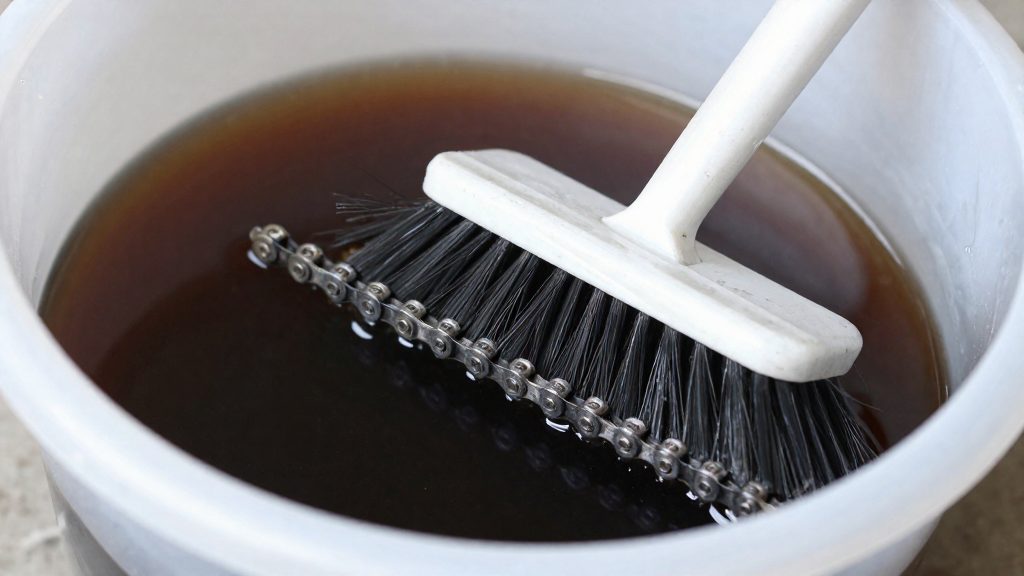
| 1 | Degrease the chain with a degreaser | Removes grit and old lube, so particles are not pushed into the links |
| 2 | Dry the chain fully if you used a water-based degreaser | Stops moisture from being sealed under the lube film |
| 3 | Apply the lube sparingly to the rollers while backpedalling the chain | Gives each roller a thin coat without flooding the plates |
| 4 | Wipe off the excess with a clean, lint-free cloth | Leaves lube where it works, rather than on the outer plates |
The order matters. Lubing a dirty chain washes grit into the links, so degreasing comes first.
If you used a water-based degreaser, dry the chain fully before applying any lube.
Applying lube sparingly is equally important. Excess lube on the outer plates attracts dirt, which in wet conditions forms a grinding layer over the chain. Working the chain backwards while applying the lube lets the product reach the rollers and pins, where the friction occurs, and wiping the chain afterwards removes what would otherwise stay on the outside.
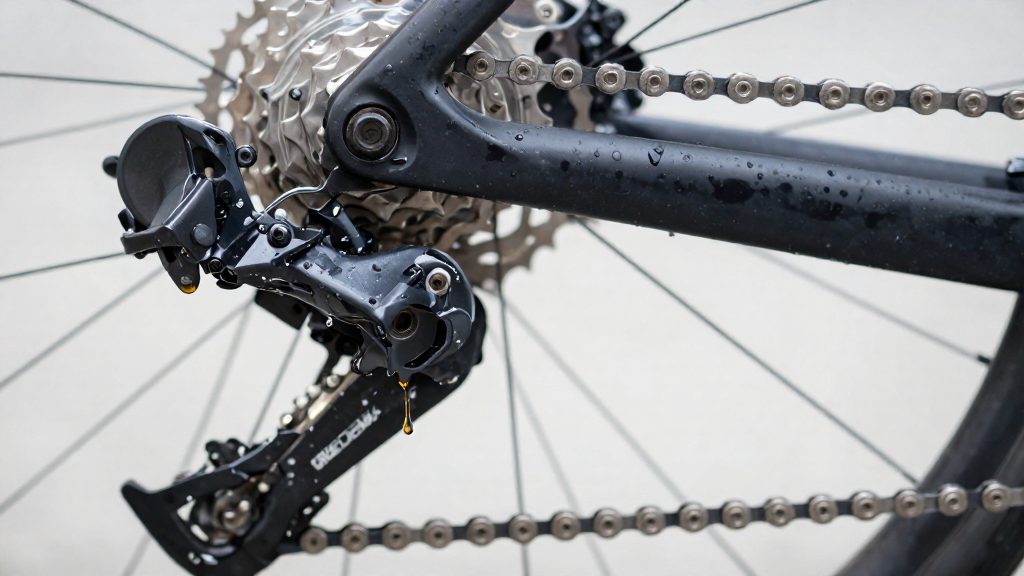
Should you use WD-40 on a bike chain?
No, not as your chain lubricant. According to road.cc (2025), WD-40 is a water-displacement product. Its job is to push water out of a component, which is a different task from lubricating the moving links of a chain. road.cc’s guidance is that WD-40 should be used only before proper lubrication is applied, never in place of a chain lube.
The difference matters most in wet weather, when riders are tempted to reach for a spray can. A wet-weather chain lube is thick and slow-flowing, stays liquid on the chain, repels water and helps prevent rust. According to road.cc (2025), WD-40 should not take the place of a chain lube.
| Attribute | WD-40 | Wet-weather chain lube |
|---|---|---|
| Primary function | Water displacement | Lubrication for wet and rainy conditions |
| Where it fits | Only before proper lubrication is applied | Applied to the chain as the lubricant |
| Water and rust | Displaces water from the component | Repels water and helps prevent rust |
WD-40 displaces water but is not a chain lube, so riding on it alone leaves the chain without proper lubrication.
If you use WD-40 at all, treat it as a preparatory step. Once the chain is ready for lubrication, apply a wet-weather chain lube so that the chain has the lubricant it needs for riding in rain or on wet roads.
How often should you relube in wet conditions?
In wet weather, the riding condition should set the reapplication schedule, not the calendar. According to road.cc (2025), riders in wet conditions should reapply sooner than they would in dry conditions. The interval is shortest for dry lube, which needs more frequent reapplication. Wet lube can go longer between applications. The sources give no fixed mileage or time interval, only that dry lube needs more frequent reapplication than wet lube.
Use these triggers to decide when to lubricate:
| Trigger | Action |
|---|---|
| Ride through standing water | Relube after that ride, even if the chain looked fine when you set off |
| Riding in rain or road spray | Inspect the chain after the ride and relube if it has lost its sheen |
| Dry, dull chain before riding | Lubricate before the next ride |
The visual check is the most reliable test between scheduled applications. A chain that looks dry and dull may need fresh lube, so check it before riding. Road.cc (2025) advises reapplying sooner in wet weather than in dry conditions. Look at the chain links and rollers before each ride, especially after a wet day or a wet night outdoors.
Eco-friendly and all-weather options
A biodegradable wet lube and an all-weather formula both aim to keep the chain protected when rain is part of the ride. A wet lube suits a rider who mainly rides in rain, while an all-weather formula is positioned for both wet and dry riding.
Road.cc (2025) lists Green Oil Wet and Fenwicks Wet Weather as biodegradable wet-weather options. Green Oil Wet is also given a claimed figure of 125+ miles per application. That is a claim, not a measured interval, so use it as a rough upper reference rather than a schedule. Both sources are UK-based, so check availability from US retailers.
| Product | Formula type | Source |
|---|---|---|
| Green Oil Wet | Wet, biodegradable, claimed 125+ miles per application | Road.cc (2025) |
| Fenwicks Wet Weather | Wet, biodegradable formula | Road.cc (2025) |
| Peaty’s LinkLube Wet Weather | Wet weather | Road.cc (2025) |
| Wolf Tooth WT-1 | All conditions | Road.cc (2025) |
| Peaty’s Link Lube Premium All Weather | All-weather; BikePerfect names it best overall | BikePerfect (2024) |
| Silca Synergetic Wet Lube | Performs in wet and dry conditions | BikePerfect (2024) |
The choice between the two groups depends on your riding pattern. A rider who switches between dry and wet days should not rely on a dry formula alone. Options for riders whose routes change from dry to wet include Wolf Tooth WT-1 (all conditions, road.cc 2025), Peaty’s Link Lube Premium All Weather (BikePerfect 2024) and Silca Synergetic Wet Lube, which BikePerfect says performs well in both wet and dry conditions.
Biodegradability is the main environmental differentiator in this group. Green Oil Wet and Fenwicks Wet Weather are the options road.cc identifies with that property, so riders who prioritise it should start with those two. Products in the all-weather category are not described with a biodegradable claim in the cited sources, so check the label of any all-weather product you are considering if environmental impact matters to you.
Frequently asked questions
How much wet lube should I apply to the chain?
Road.cc (2025) advises applying lube sparingly and then wiping off the excess. The excess lube you wipe away is what would otherwise sit on the outer surface of the chain, so the protective film is left inside the links where it works.
Can I use WD-40 to clear water off my chain before a ride?
Road.cc (2025) describes WD-40 as a water-displacement product, so it can help push moisture out of the chain. It does not replace a chain lube, so apply a proper lube once the water has been displaced.
Which wet-weather lube should a beginner try first?
Road.cc (2025) lists Wolf Tooth WT-1 as its all-conditions pick, and BikePerfect (2024) names Peaty’s Link Lube Premium All Weather as best overall. Both publications are from the UK, so check whether these brands are stocked by your local or US retailers before buying.