How often should a road bike be serviced?
Baseline intervals
Elevation Outdoors gives general guidelines that depend on riding volume, terrain and conditions. Apply the calendar and the odometer together, and treat whichever limit comes first as the usual trigger (2,500 miles is about 4,000 km and 5,000 miles is about 8,000 km):
| Condition | Service due |
|---|---|
| Six months have passed and the bike has covered under about 4,000 km (2,500 miles) | Professional tune-up |
| 2,500 miles are reached before six months have passed | Professional tune-up |
| One year has passed and the bike has covered under 5,000 miles | Major overhaul |
| 5,000 miles are reached before one year has passed | Major overhaul |
Why mileage and calendar limits both apply
Mileage tracks the wear that riding causes, such as drivetrain and brake wear, which accumulates with every kilometre or mile. The calendar limit covers wear that happens without riding: lubricants dry out and moisture reaches exposed metal, even on a bike that is ridden only occasionally. A bike that reaches 2,500 miles in four months should be serviced at that point rather than waiting for the six-month mark, and a bike ridden very little may need a professional tune-up less often. Light and casual riders are advised an annual tune-up in the rider-profile table below.
What the annual overhaul adds
Record the date and odometer reading at every service. Without both figures, you cannot tell which limit has been reached first.
Quick checks before every ride
Spirited Cyclist (2026-05-16) recommends checking tyre pressure, brakes, wheel security and unusual noises before every ride. The checks below cover tire pressure, wheel security and noises. Also test the brakes before every ride by squeezing each lever and confirming firm resistance before it reaches the bar. These checks are meant to be done each time, not only at service intervals. They target faults that can cause a crash, so they take priority over wear measurement.
| Check | How to perform it | Sign of a problem |
|---|---|---|
| Tyre pressure | Measure with a gauge and compare against the range on the sidewall | Soft feel, or a reading below the range |
| Wheel security | Lift the wheel, spin it, and grip the rim at 12 and 6 o’clock | Lateral wobble, play, or a loose quick-release skewer |
| Noises | Spin each wheel slowly, then ride a few metres at low speed | Rubbing, ticking or grinding that repeats with each revolution |
Tyre pressure
Press the tyre with your thumb and compare its firmness with the previous ride. A tyre that feels softer than usual may have lost air or have a slow leak. Confirm with a gauge, because touch cannot reliably judge pressure. Use the value printed on the sidewall as the maximum, and inflate to the pressure recommended by the tyre manufacturer, staying within the printed range.
Wheel security and quick-release closure
Lift each wheel off the ground and spin it. Watch for side-to-side movement, which indicates a loose hub or a damaged rim. For a quick-release skewer, the lever should close with firm resistance and leave a clear imprint in the palm. If it closes with little effort, open it, rotate the adjusting nut on the opposite side, and close it again. Confirm the lever sits on the side the frame’s instructions specify. Thru-axles follow a different procedure, so check the manufacturer’s instructions for that fitting.
Listening for abnormal noises
Spin each wheel slowly and listen for rubbing, ticking or grinding. Then ride a few metres at low speed. A repeating noise that follows each wheel revolution points to a rotating part or a rubbing contact. A noise that changes with steering or pedalling points to a different source. To isolate it, apply light pressure to individual components and repeat the spin test.
Chain, cables and bearings: when to replace
These three components wear on different schedules, so each needs its own check. Elevation Outdoors (2022) gives the intervals below for road bikes. The chain needs the most frequent attention because chain wear builds up with every ride and affects how the drivetrain meshes. Control cables and their housing wear more slowly, but a fraying inner cable can fail suddenly, which is why they are inspected twice a year and replaced yearly. Wheel bearings are checked once a year, since their wear develops slowly and is easiest to detect by hand.
| Component | Check interval | Replacement point |
|---|---|---|
| Chain | Every 3 months | At 50% wear, or annually at the latest (about 5,000 mi) |
| Control cables and housing | Every 6 months | Replace annually |
| Wheel bearings | Annually | Replace when play or roughness is found at the check |
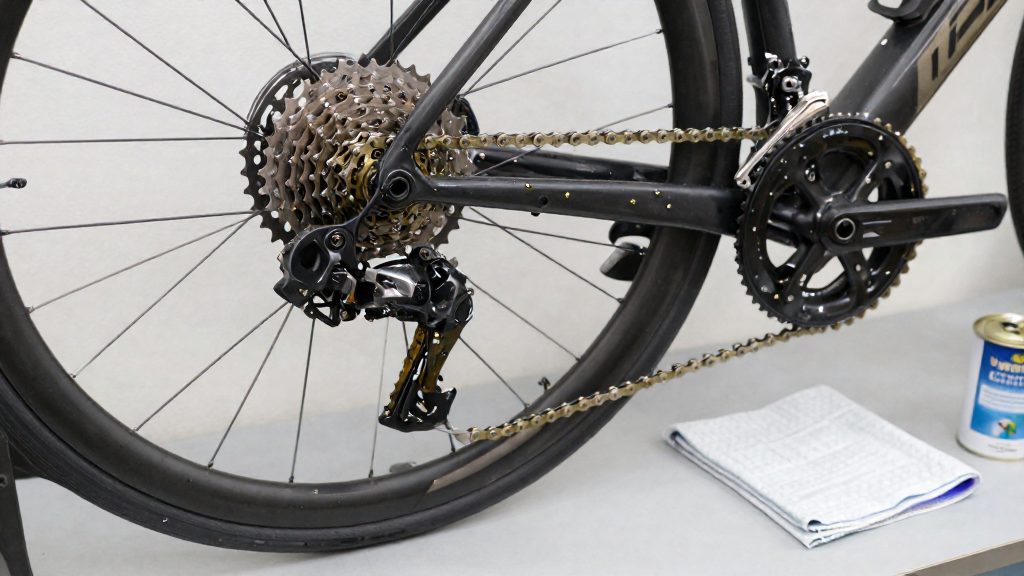
To measure chain wear, use a chain checker, a tool that measures how far the chain has stretched over a fixed length of links. Read it at each quarterly check and log the result, so you can see when the reading reaches the 50% threshold rather than estimating it by eye.
For cables and housing, look along the full length of each outer housing for kinks, cracks and flattened sections. At the cable ends, check for fraying on the inner wire and for rust near the metal end caps. Then operate each brake and gear lever through its full travel. Stiff or sticky action often means the housing is compressed or the cable is contaminated, and both are reasons to inspect the run more closely.
For a wheel bearing check, lift the wheel off the ground and grip the tyre at the top and bottom. Rock it side to side: any clicking or movement felt at the hub indicates play. Then spin the wheel by hand and listen and feel for roughness or a grinding sensation. Repeat on the other wheel and compare the two, since a difference between hubs points to the worn one.
Does your riding style change the schedule?
Ride frequency, weekly distance and exposure to wet weather change how often a road bike needs a professional tune-up. Tern Bicycles (2026) and Spirited Cyclist (2026-05-16) both tie their intervals to rider profile, but they use different cut-offs, so the table keeps each source’s conditions intact.
| Rider profile | Riding pattern | Tune-up interval | Source |
|---|---|---|---|
| Light rider | Once or twice a month, dry weather only | Annually | Tern Bicycles (2026) |
| Recreational rider | Once or twice a week, mostly dry weather | Quarterly | Tern Bicycles (2026) |
| Frequent rider | About 100 km a week | Every two months | Tern Bicycles (2026) |
| Heavy daily rider | Riding every day | Monthly | Tern Bicycles (2026) |
| Casual rider | Occasional riding | At least once a year | Spirited Cyclist (2026-05-16) |
| Regular rider | 2–4 rides a week | Every 6 months | Spirited Cyclist (2026-05-16) |
| High-mileage or off-road rider | High mileage or off-road riding | Every 3 months | Spirited Cyclist (2026-05-16) |
To place yourself in a tier, count rides over a typical month rather than a best month. Riders who ride in rain should check the riding-pattern column first. Tern’s light-rider tier applies only to dry-weather riding, so anyone riding regularly in wet conditions falls outside it, even at low volume.
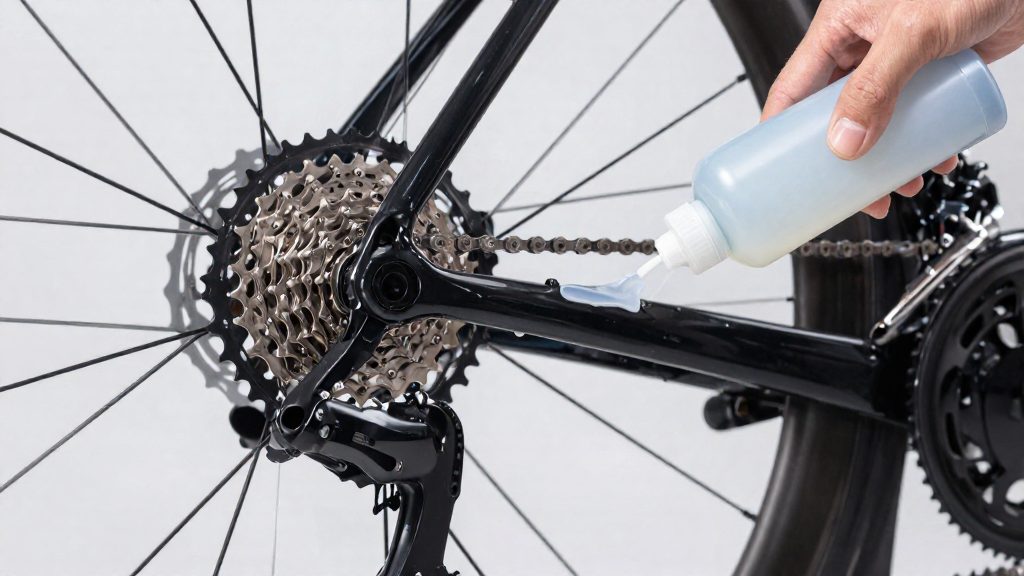
Wet and muddy rides affect the bike between tune-ups. Spirited Cyclist recommends cleaning the bike and re-lubing the chain every few weeks, or after wet, muddy or dusty rides. Treat this as a separate routine from the professional service: the cleaning schedule follows the terrain you ride, while the tune-up follows mileage and frequency.
How often should e-bikes be serviced?
Tern’s e-bike schedule sets two fixed points: a first service after the bike is new, then a recurring six-monthly check. The table below lists each trigger and what it covers.
| Service point | Interval | Purpose |
|---|---|---|
| First service | One month or 200 km after purchase | Initial professional check of a new e-bike |
| Routine professional check | Every six months or 1,000 km | Recurring inspection of the bike |
| Dealer custom interval | Set by the dealer | Replaces the standard interval when programmed |
| Bosch display service indicator | Shown on the display | Signals that a service is due |
Because dealers can set custom intervals, confirm the interval programmed into your bike before relying on the standard figures above.
Battery and motor upkeep has no separate interval in Tern’s schedule, so these components are covered through the professional checks. To make the 200 km and 1,000 km triggers usable, record the purchase date and odometer reading in a simple log, and note the date and mileage of every service. When you book a check, ask the workshop to inspect the battery connectors, the motor drive unit and the display, and to record the result on the service paperwork. Keep the battery charged according to the instructions in your owner’s manual, since Tern’s published schedule does not specify battery storage charge levels.
Signs your bike needs service sooner
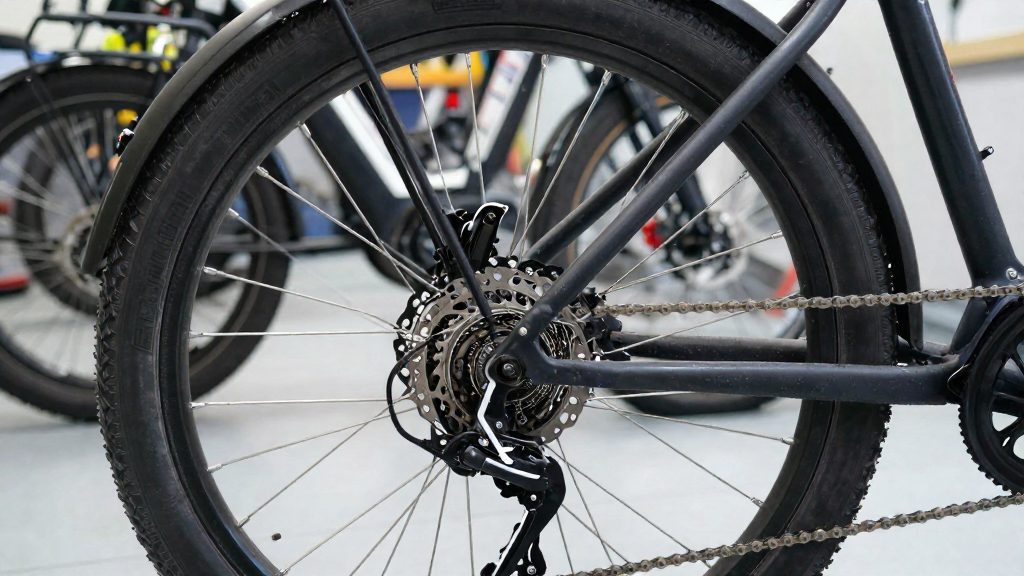
Some symptoms justify a service before the regular interval arrives. Spirited Cyclist (2026-05-16) advises servicing sooner for shifting hesitation, chain skipping, persistent brake squeal, rotor rub, loose headset play and wheels that no longer run true. The table lists the first check for each symptom, and the sections below explain how to narrow down the cause.
| Symptom | First check | If unresolved |
|---|---|---|
| Chain skips under pedalling load | Shift one step at a time and watch whether the chain climbs the cog | Book a drivetrain inspection |
| Shifts hesitate or take several attempts | Shift slowly through the range while watching the derailleur | Book a derailleur and cable inspection |
| Brake squeal returns after cleaning | Inspect pad surfaces and the braking track for contamination | Book a brake inspection |
| Rotor rubs with the wheel spinning freely | Look for a bent rotor or a caliper set off-centre | Stop riding and book a service |
| Wheel no longer runs true | Spin the wheel and watch the rim against a fixed point | Book a wheel truing |
Gear skipping and hesitant shifting
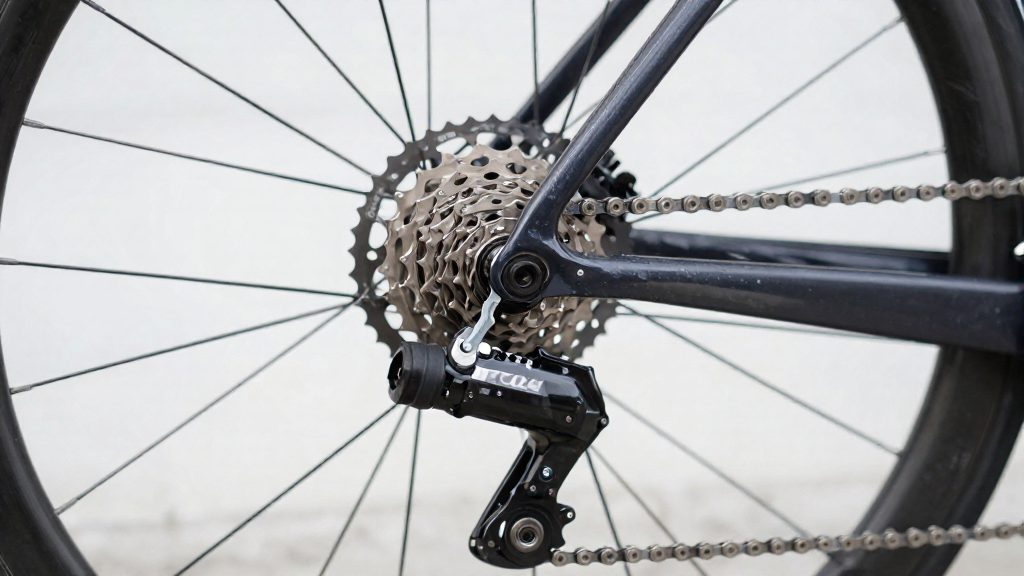
Gear skipping under load points to a different fault than a shift that is merely slow. Skipping that happens only when you push hard on the pedals suggests the chain is not seating correctly on the cog. A slow or sticking shift, where the lever moves but the derailleur responds late, usually points to the cable or housing. Shift one gear at a time with the bike stationary, then repeat the check while pedalling lightly. If the fault persists, have the derailleur alignment and cable tension inspected rather than repeatedly adjusting the barrel adjuster.
Brake squeal, fade and lever travel changes
Squeal that persists after cleaning can come from contaminated pads or braking surfaces, or from a mechanical cause, so inspect it rather than cleaning again. Check the pads for uneven wear and the caliper for alignment. A rotor that rubs while the wheel is freely spinning can indicate a bent rotor or an off-centre caliper.
A lever that feels softer or travels further than it did earlier is a warning sign, even when the pads still have material. Have the brakes inspected before riding at speed. Compare the lever feel with your last known good setup. Test the brakes at walking pace in a safe, open area before riding at speed.
Creaking, clicking and bottom bracket play
Creaks and clicks often appear under load or at fixed pedal positions, which makes the source hard to isolate by ear alone. Start with the bottom bracket play test. With the chain lifted off the chainrings and the cranks still fitted, grip each crank arm and try to rock it side to side. Movement that feels distinct from normal bearing rotation indicates looseness at the bottom bracket.
Next, check the headset. Hold the front brake, rock the bike forward and back, and feel for knocking at the head tube. Applying lubricant to a loose component will mask the noise without fixing it, so tighten or service the part first.
Should you service at home or visit a shop?
Home maintenance covers tasks that need a few hand tools and patience. Some adjustments need specialised equipment and experience that a shop provides. Elevation Outdoors (2022) suggests a professional tune-up every six months (about 2,500 miles) and a major overhaul once a year (about 5,000 miles) as general guidelines that depend on riding volume, terrain and conditions. Those figures set the professional baseline, and the home workshop covers the work between visits.
Two tools make the most difference at home. A torque wrench lets you tighten bolts to the manufacturer’s specified value rather than by feel, which avoids overtightening. A chain checker measures stretch so you can track wear over time. Cleaning, lubrication and routine cable adjustment also suit a basic home workshop.
| Task | Home workshop | Shop |
|---|---|---|
| Bolt tightening with a torque wrench | Yes | No |
| Chain wear check with a chain checker | Yes | No |
| Wheel truing | No | Yes |
| Headset adjustment | No | Yes |
| Bottom bracket service | No | Yes |
Wheel truing, headset and bottom bracket work usually need specialised tools and practised technique. Treat the ‘No’ entries in the Home column as ‘shop, unless you own the tools and have practised the procedure’.
The trade-offs come down to cost, time and skill. A shop charges labour for each visit, so frequent professional service adds up quickly. Home work avoids labour costs but requires buying tools and learning the procedures, and the tools are reusable across many services. Shop work takes less of your time per task, while home work fits around your schedule. Skill is the limiting factor: if a job calls for a specialised tool you do not own or a procedure you have not practised, the shop is the safer choice. Spirited Cyclist (2026) advises that casual riders need a professional tune-up at least once a year, and regular riders need one every six months, so most owners combine a home routine with periodic shop visits.
Seasonal servicing for Canadian riders
Canadian riders typically face a seasonal sequence: a late-season service, a long storage period, and a reactivation check before the first ride. Road salt, meltwater and cold storage are the main reasons a bike that ran well in autumn can show problems in spring. The steps below cover each stage.
Pre-winter service and storage preparation
Book the professional tune-up before the bike goes into storage. Ask the workshop to check the items that wear slowly but fail badly when left alone.
| Task | Method | Source |
|---|---|---|
| Check cables and housing | Look for fraying, stiffness and corrosion; replace if worn | Elevation Outdoors (2022): check every six months, replace annually |
| Store indoors | Keep the bike in a dry, frost-free space | General practice |
Store the bike hung or on a stand, away from garage floors where meltwater collects.
Road salt cleaning and corrosion prevention
Salt residue causes more damage than dirt, so clean it off promptly. Spirited Cyclist (2026) advises cleaning the bike and re-lubing the chain after wet, muddy or dusty rides. In practice, rinse the drivetrain and frame with low-pressure water, dry the chain and cassette, then apply a fresh layer of chain lubricant and wipe off the excess. Dry the bare metal parts of the frame, the seatpost and the quick-release skewers as well.
Spring reactivation service before first rides
Before the first ride, check tyre pressure, brake function, wheel security and any unusual noise. Spirited Cyclist (2026) treats these checks as a pre-ride routine, so run them after storage as well. Spring is also when the first full tune-up of the season should be booked, which keeps the reactivation check and the scheduled service in one visit.
Frequently asked questions
Can a casual rider stick to one professional service a year?
Spirited Cyclist (2026) says casual riders need a professional tune-up at least once a year. If your odometer reaches 2,500 miles before the year is up, bring the service forward.
Which symptoms mean I should book a service before the next interval?
Shifting hesitation, chain skipping, persistent brake squeal, rotor rub, loose headset play and wheels that no longer run true all call for an early service, according to Spirited Cyclist (2026). Any of these can point to wear or misadjustment that worsens with each ride.
How often should I clean and re-lube the chain?
Spirited Cyclist (2026) recommends cleaning the bike and applying a fresh coat of chain lubricant every few weeks. Do the same after wet, muddy or dusty rides, because grit trapped in the drivetrain wears the chain faster than normal riding does.