What you need to clean a bike chain at home
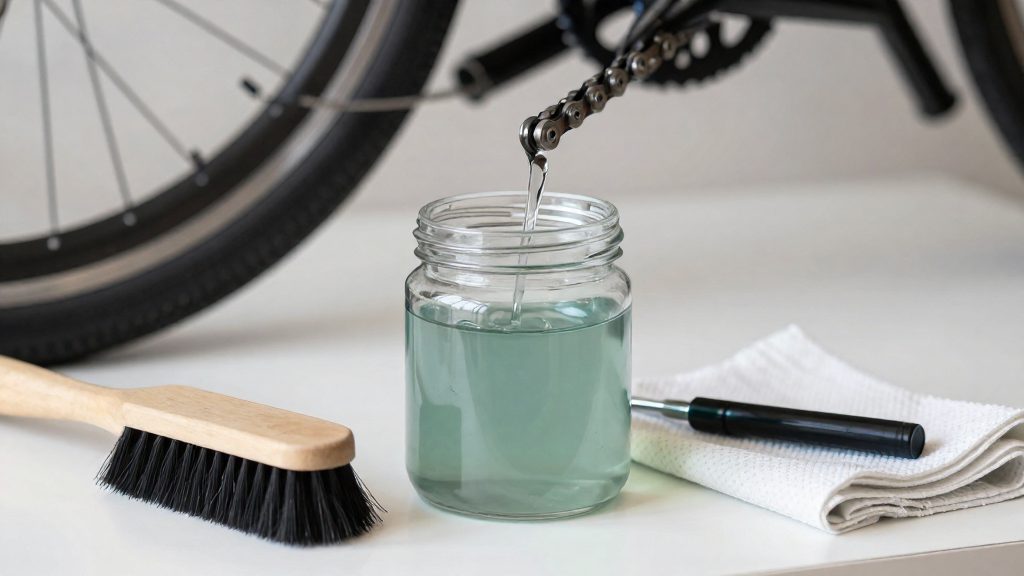
A basic chain-cleaning kit needs five items: a brush, a bike-specific degreaser, soapy water, rags and gloves. A chain cleaner tool and a repair stand make the job easier but are not essential.
| Item | Role in the job |
|---|---|
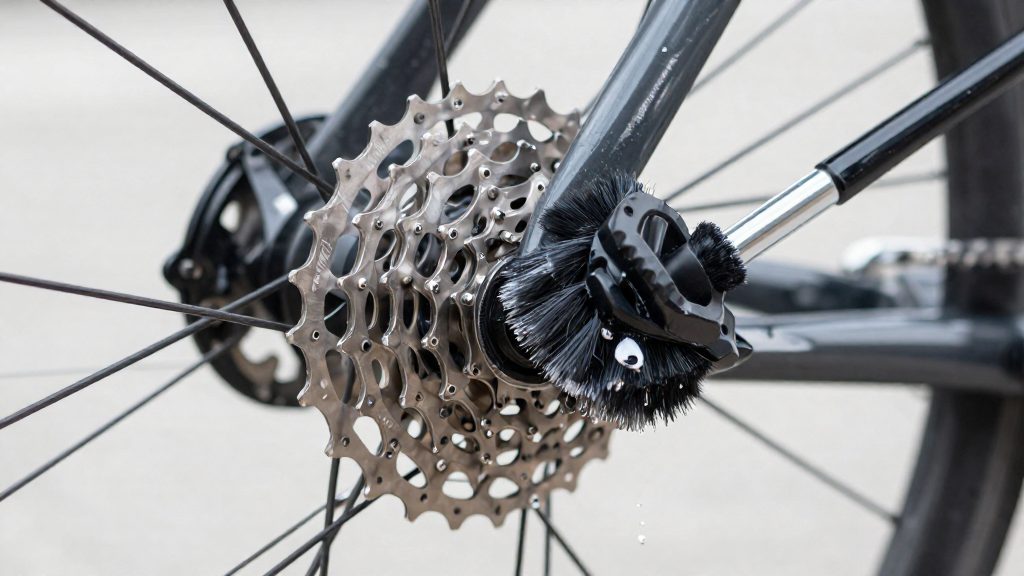
| Chain cleaner tool | A clamp-style device with brushes that wraps around the chain, so you can scrub it without fully removing it from the bike. |
| Scrub brush | A brush such as a toothbrush cleans the top and bottom of the chain when you have no chain cleaner tool. |
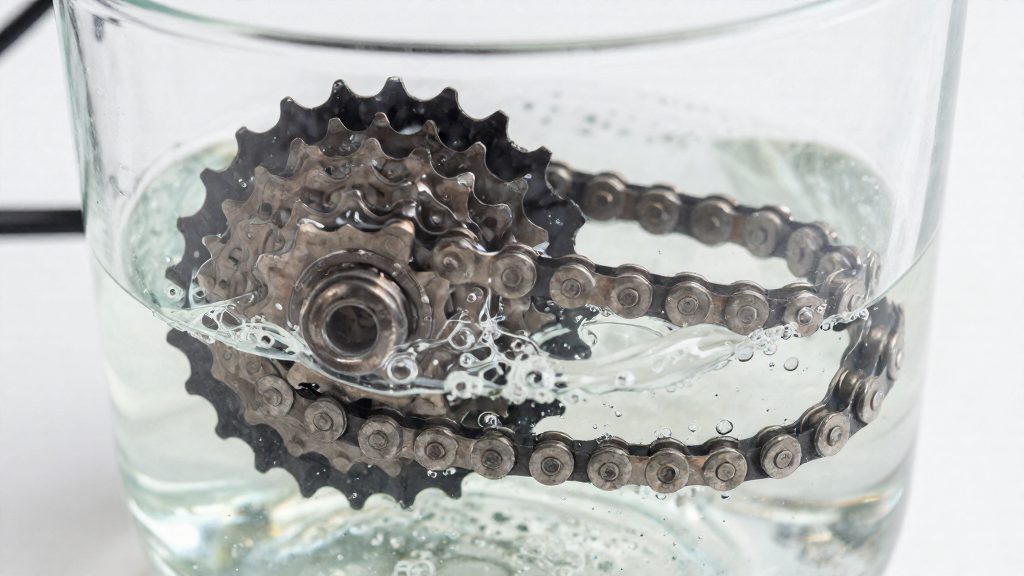
| Bike-specific degreaser | Dissolves the oil and grime that bind to the rollers and plates. Trek recommends a degreaser made for bicycles. |
| Soapy water | Used for a final wipe, after the degreaser, to remove residue. |
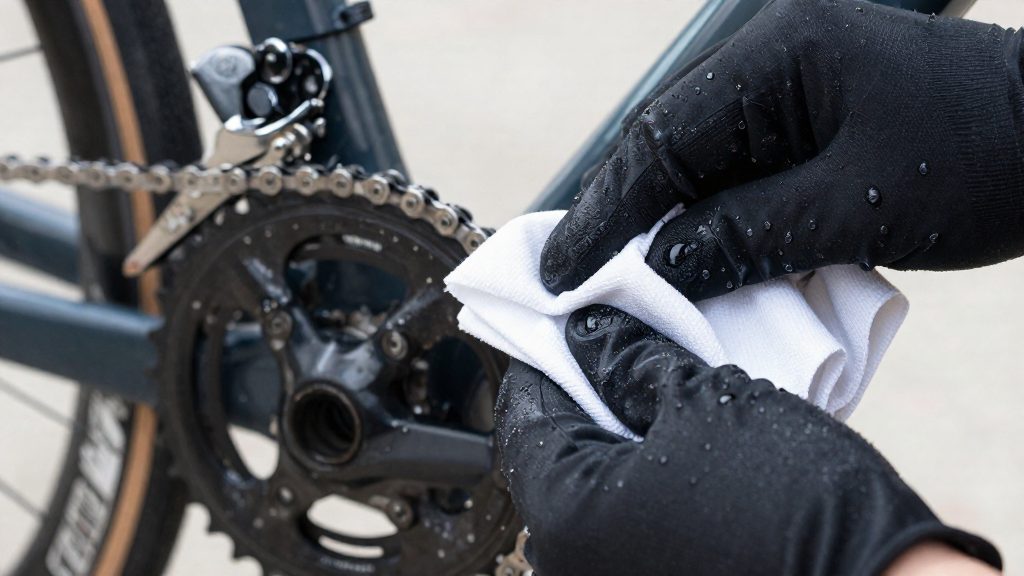
| Rags | Wipe down the chain, chainrings and cassette before and after cleaning. |
| Gloves | Protect your hands from degreaser and black grime. Trek advises wearing them. |
| Repair stand (optional) | Holds the bike at a working height. Trek notes it is optional. |
Using the brush and degreaser without a cleaner tool
If you have no chain cleaner tool, a brush and a small amount of degreaser are enough. Trek’s method is to dip the brush in degreaser and scrub the chain while backpedaling, which moves the chain through the brush.
Choosing between a stand and propping the bike
A repair stand holds the frame steady and keeps both hands free. Without one, you can prop the bike so the rear wheel spins freely, which Freewheel recommends. Either option works. A stand is optional, according to Trek.
How do you clean a bike chain step by step?
Chain cleaning on the bike means moving the chain through degreaser and rinse while the drivetrain turns, without removing it. Two approaches are common: the backpedal scrub, which needs only a brush and degreaser, and the freewheel setup, which fixes the chain in one position and lets the wheel turn freely.
Backpedal scrub with a brush
According to Trek Bicycle (Canada site) (2026), if you do not have a chain cleaner tool, scrub the top and bottom of the chain with a brush, such as a toothbrush, dipped in bike-specific degreaser. Once the chain is scrubbed, wipe it with soapy water and rinse off the excess degreaser.
Work in short passes rather than one long pass. Each section of chain that has passed the brush should be checked before you move on, so that no area is missed.
Freewheel setup
Freewheel (2026) describes a fixed-position method that gives the chain a stable path to clean:
- Shift to the smallest chainring and the smallest cog on the rear cassette.
- Prop the bike so the rear wheel spins freely.
- Degrease and scrub the chain.
- Rinse the chain.
- Dry the chain thoroughly.
Because the rear wheel spins freely, you can turn the pedals with one hand and hold the brush against the chain with the other, using the same brushing motion as in the backpedal method. Lubrication comes after step 5, not before.
Drying before re-lubing
Road Bike Rider (2026) states that a wet chain must be dried fully before re-lubing, because moisture dilutes the new lube. Before applying any product, check that the rollers and link plates show no residual water or degreaser film. A chain that still feels slick or looks cloudy after rinsing is not yet ready for lube.
How do you lubricate a bike chain properly?
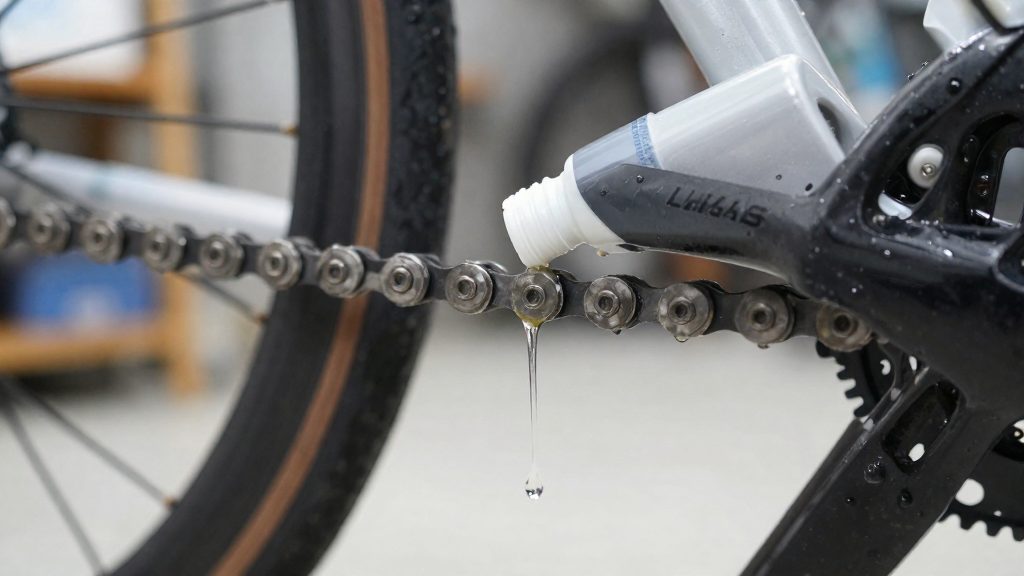
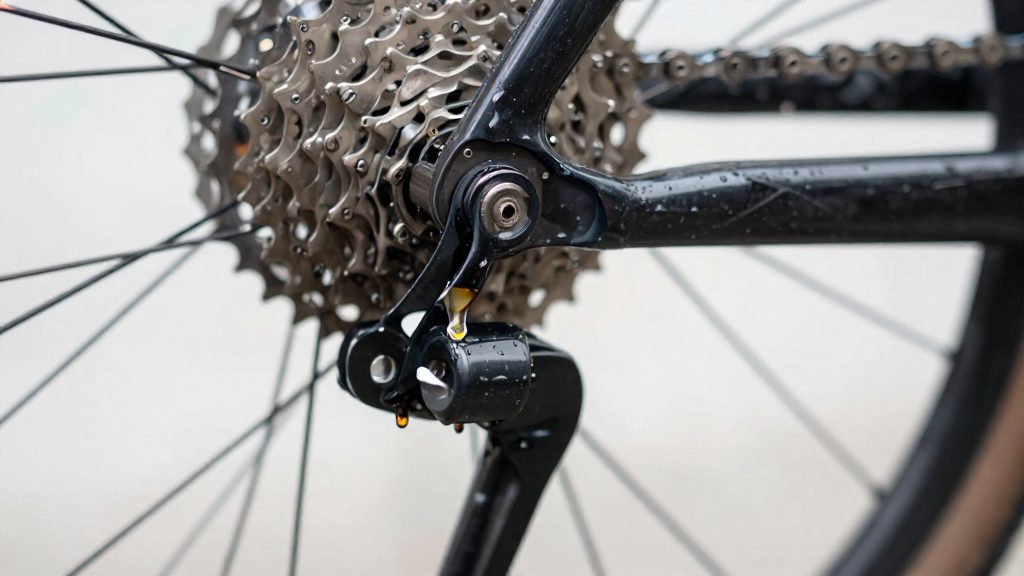
Chain lubrication works best when a small amount of lube reaches the rollers, the parts that pivot between the chain’s plates, and the excess is removed before the bike is ridden. Trek Bicycle (Canada site, 2026) advises placing a small drop on each roller and then wiping off the excess. The steps below follow Freewheel (2026), which describes lubing with the bike held in a stationary position.
| Step | Action | Source |
|---|---|---|
| 1 | Shift to the smallest chainring and smallest cog | Freewheel (2026) |
| 2 | Prop the bike so the rear wheel spins freely | Freewheel (2026) |
| 3 | Add one drop of lube per link while turning the pedals | Freewheel (2026) |
| 4 | Wipe off the excess lube | Trek Bicycle (Canada site, 2026) |
| 5 | Let the lube settle before riding | Road Bike Rider (2026) |
Applying the drop
Turn the pedals slowly while the drop falls, so each roller receives lube as it passes the nozzle. Holding the bottle steady and dispensing one drop per link keeps the amount controlled. A continuous stream or a large puddle wastes lube and leaves more to clean up in step 4.
Wiping off the excess
After the drop is applied, hold a clean, lint-free cloth against the chain and pedal backwards to pass the links through it. The aim is to remove the lube that has not gone into the rollers, leaving a thin film rather than a coating.
Letting the lube settle
Once the chain is wiped, leave the bike still for the settling time. Road Bike Rider (2026) recommends a wait of 10 to 15 minutes before riding. During this period the lube works into the rollers, so the chain starts the ride with its lubricant in place rather than being pushed out by the first pedal strokes.
Wet lube or dry lube: which should you choose?
The choice between wet lube and dry lube depends on the conditions you ride in. Trek Bicycle (2026) recommends wet lube for wet or muddy rides and dry lube for dry conditions. Rain and mud expose the chain to water and fine particles that can wash a lubricant off the rollers, so a lube designed to stay in place under those conditions suits wet riding. In dry, clean conditions there is little water to contend with, and the main concern shifts to keeping the chain free of grit. A lube formulated for dry use fits that environment better.
Matching the lube to the weather is a practical habit rather than a fixed rule. If your routes alternate between wet and dry, base your choice on the conditions you encounter most often, and keep the chain’s condition in mind on the days that differ. If conditions change with the seasons, revisit your choice of lube.
Terrain matters as much as weather. Off-road riding through mud or wet soil brings abrasive material into contact with the chain more often than paved riding does, which makes the wet-condition choice more relevant on trails than on the road.
How often should you clean and lube your chain?
Service frequency depends on two factors: how many miles you ride and how much grit, water and mud reach the drivetrain. Trek Bicycle (Canada site) (2026) gives a calendar baseline: clean and lube the chain at least once a month if you ride regularly, and more often if off-road riding leaves it muddy. Road Bike Rider (2026) gives a distance-based schedule, which is more useful when conditions change from ride to ride.
Re-lube intervals by riding conditions
| Riding conditions | Re-lube interval |
|---|---|
| Dry, fair weather | Every 100–150 miles (about 160–240 km) |
| Mixed conditions | Every 50–75 miles |
| Wet or muddy ride | After every ride |
Apply whichever threshold comes first. A rider who logs 60 miles in mixed weather should re-lube at that point, even if the month has not ended. Frequent off-road riding usually pushes you toward the shorter mileage intervals, because the chain collects abrasive debris faster than on paved routes.
Re-lubing after a wet or muddy ride
After a wet or muddy ride, Road Bike Rider (2026) suggests re-lubing every time. Dry the chain fully first, because moisture dilutes the new lube.
Keep a simple log of miles and weather for the first few months. Within one or two seasons, the log shows how quickly your chain gets dirty on your usual routes, which is more reliable than any fixed schedule.
Mistakes to avoid when cleaning a chain
Most chain damage during home maintenance comes from a few habits rather than from the cleaning itself. The errors below either remove the lubricant the chain depends on or leave lube and grit where they do the most harm.
The first error is soaking the chain in degreaser or removing it for cleaning. Road Bike Rider (2026) reports that manufacturers generally advise against removing the chain, and that soaking can strip the internal lubricant.
The second error is putting lube on the outer surface of the chain. Trek Bicycle (Canada site) (2026) states that lube on the outside attracts dirt. Grit that settles on the plates is carried into the rollers with every pedal stroke, where it works as an abrasive. Lube belongs on the rollers, where the chain’s moving parts meet.
The table summarises the main errors and the practice that avoids each one.
| Mistake | Consequence | Correct practice |
|---|---|---|
| Lubing the outer plates | Attracts dirt that is pushed into the rollers (Trek Bicycle (Canada site), 2026) | Place a small drop on each roller only |
| Leaving excess lube on the chain | Collects grit on the outside of the chain | Wipe off the excess after applying lube |
Working through the chain one link at a time also makes it easier to spot links that are still dry or have not taken lube.
When is a chain worn out and due for replacement?
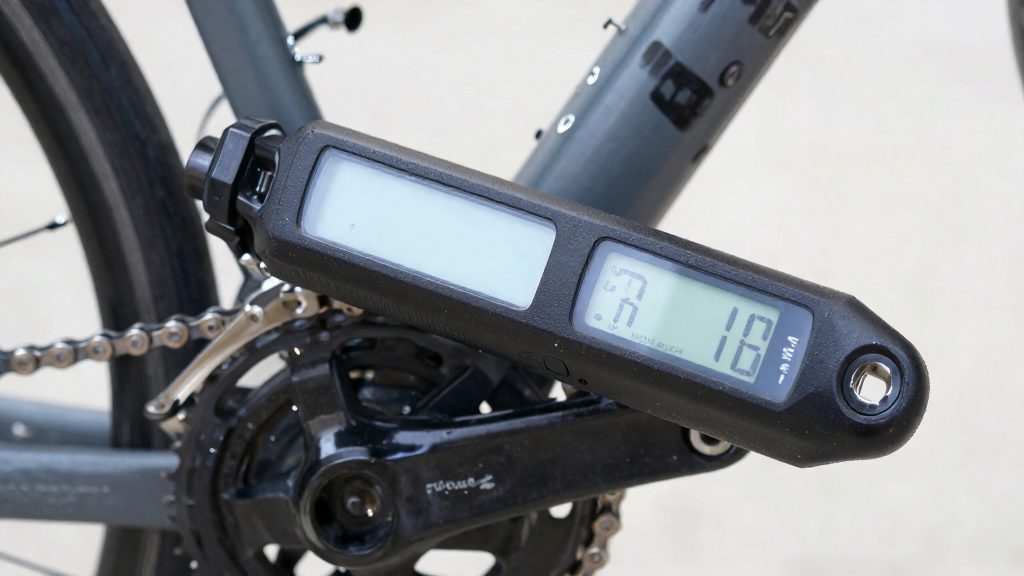
A chain wears by elongating, a condition often called chain stretch. The pins and rollers wear slightly with each pedal stroke, so the distance between links grows. Because a new chain has a fixed length, you can measure this elongation directly with the 24-link method: a new chain measures exactly 12 inches (about 305 mm) across 24 links, and the same 24 links measure longer as the chain wears.
To take the measurement, use a steel ruler or a dedicated chain checker. Clean the chain first so dirt does not affect the reading, then measure from the centre of one pin to the centre of the pin 24 links further along. Repeat the measurement at several points along the chain, because wear is rarely even. Compare each reading with the thresholds below, based on Road Bike Rider (2026):
| Measured span over 24 links | What it means |
|---|---|
| 12 inches | New chain, reference length |
| About 12 1/16 inches | Replace the chain |
| 12 1/8 inches | Chain is worn far enough that the cassette may also need replacing |
The step from the replacement threshold to the cassette threshold is small, so a chain left in service past 12 1/16 inches shortens the time before the cassette is affected. Checking the chain at regular intervals is more reliable than estimating its condition by eye, since a chain can look serviceable while already past the replacement point.
When you fit a new chain, measure it again across 24 links after a few rides and record the result. This gives you a baseline for the next check, and it shows how quickly your drivetrain wears under your riding conditions.
Frequently asked questions
How do I know when my chain is worn out?
Measure 24 links: on a new chain they span 12 inches (about 305 mm). According to Road Bike Rider (2026), replace the chain at about 12 1/16 inches (about 306 mm), because waiting until 12 1/8 inches (about 308 mm) can mean the cassette also needs replacing.
Should I use wet lube or dry lube on my chain?
Trek Bicycle (2026) recommends wet lube for wet or muddy rides and dry lube for dry conditions. Apply a small drop to each roller and wipe off the excess, since lube left on the outside of the chain attracts dirt.
How long should fresh lube sit before I ride?
Road Bike Rider (2026) suggests letting the lube settle for 10–15 minutes before riding. Make sure the chain is fully dry before you apply it, because moisture dilutes the lubricant and reduces its effectiveness.