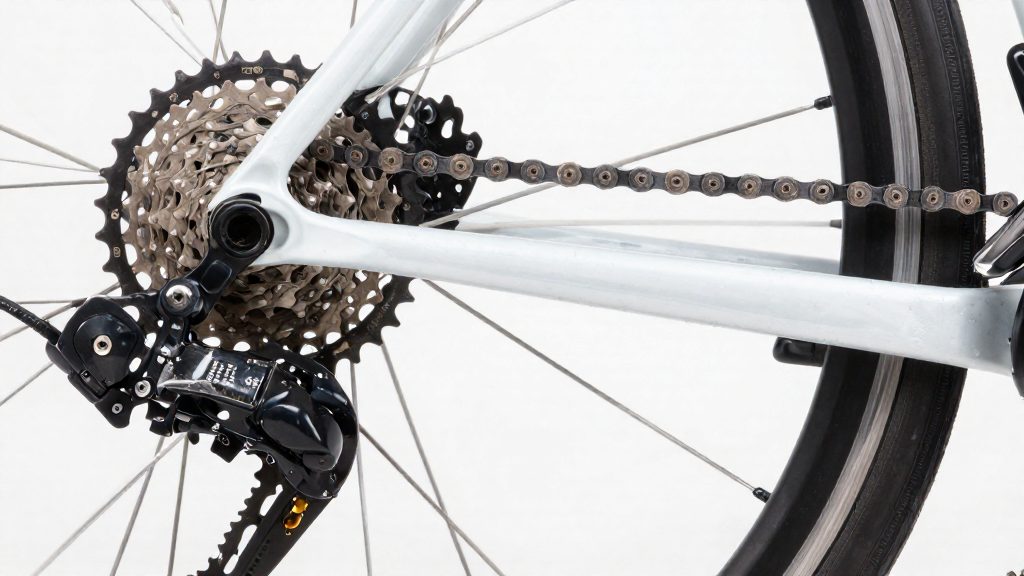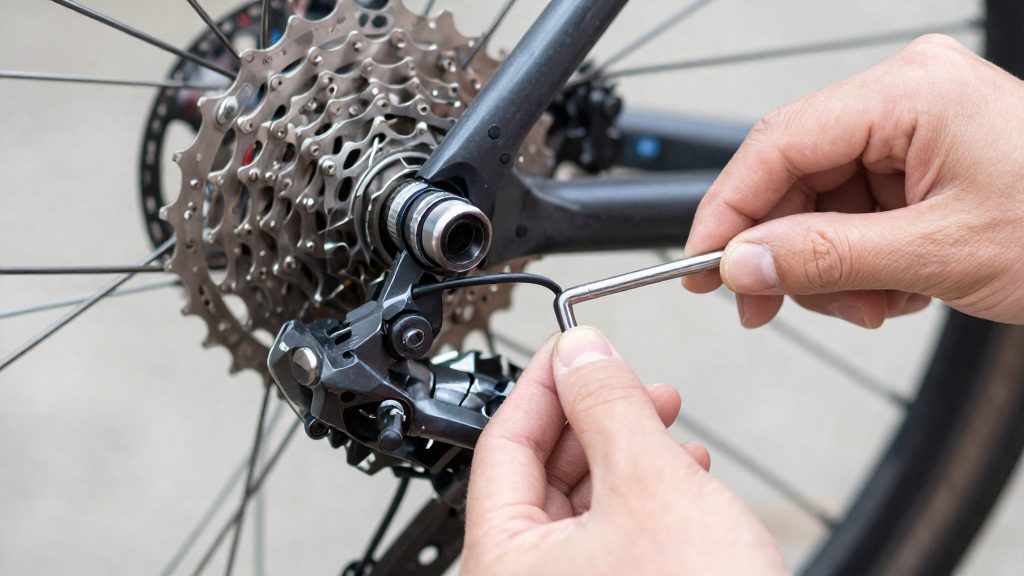
Shifts drift after a cable stretch because the inner cable lengthens and the outer housing compresses, which reduces the tension that holds the derailleur at its set position. The gears are indexed so that each click lands the chain on a specific cog. When cable length changes, the derailleur stops slightly off those positions. According to BikeRadar (2026-03-09), stretched cables are the most common cause of gears that won’t shift cleanly with one click of the shifter.
Why do shifts go off after a cable stretch?
Every shift pulls or releases the inner cable, a steel wire that runs through the housing. Under repeated load, the wire elongates slightly. Each shift then moves the derailleur a little less or more than it did when the system was adjusted, and the error accumulates over time. The cable does not return to its original length on its own.
The outer housing changes as well. Its liner and end caps compress where they meet the frame stops and the cable clamp points. This shortens the effective cable path, so the inner cable has less travel to work with and transmits less tension to the derailleur.
The derailleur is held in its indexed position by a balance between the cable pull and the return spring. When tension drops, the derailleur rests short of the position where its guide pulley aligns with the target cog. The chain then sits between teeth or hesitates to climb. Shifts that require the most cable travel are usually the first to show the problem.
| Component | What changes | Effect on the derailleur |
|---|---|---|
| Inner cable | Elongates under repeated shifting load | Less pull per shift, so it stops short of the indexed cog |
| Outer housing | Compresses at the ends and clamp points | Shorter effective cable path, so less tension is transmitted |
Signs your cable has stretched
Three symptoms point to this pattern. Three symptoms point to this pattern, and they are most useful when you compare them across the whole gear range.
Ghost shifting can accompany a stretched cable, but it is not specific to one, because a bent hanger, a worn drivetrain or a sticky housing can also cause it. The chain moves to another cog without any input from the shifter, often under load, when the derailleur spring pulls on a cable that no longer holds its set length. A chain that drifts on its own has lost the tension that keeps the derailleur in position.
A second symptom is a chain that climbs only partway onto the next cog, or skips one cog altogether. The chain lifts, then drops back or jumps past the target gear, because the cable is not moving the derailleur the full distance needed to align the chain. A stretched cable tends to affect shifts throughout the range. A failure confined to one gear more often points to a different fault.
The third symptom is changing lever travel. As the cable stretches, the slack it accumulates means the lever must move further before the derailleur responds, and each click can feel different from the last. If the lever feels longer or looser than it did when the bike was new, or one click moves the chain a different amount than the previous click, the cable is a likely cause.
| Symptom | What you observe | What it indicates |
|---|---|---|
| Ghost shifting | Chain moves between cogs with no shifter input | Cable has lost tension; derailleur drifts under load |
| Partial climb or skipped cog | Chain lifts, then drops back or jumps a cog | Derailleur moves less distance than the target gear requires |
| Inconsistent lever travel | Lever feels longer or uneven from click to click | Accumulated slack absorbs part of the shifter movement |
Tools you need
Cable adjustment and replacement at home requires only a few tools. Most of the kit is for handling the cable itself: a set of small hex keys, a dedicated cable cutter, cable end caps and a cable lubricant. None of these need specialist workshop equipment.
Small hex keys loosen and tighten the cable anchor bolt on the derailleur when the cable is replaced. Choose keys that sit fully in the screw head. A worn or undersized key rounds the head, which makes the screw much harder to turn later.
A cable cutter is designed for brake and gear cable and cuts the inner wire squarely. Pliers or side cutters tend to fray the strands and leave an angled end, which does not seat properly in an end cap and can snag inside the lever or housing. After cutting, check that the end is flat and free of loose strands before fitting a cap.
Cable end caps finish the cut end of the inner wire. They stop the strands from splaying and let the wire seat neatly in the lever or derailleur anchor. Match the cap to the cable diameter, because a mismatched cap will not hold.
Cable lubricant is applied to the inner wire before it is threaded back through the housing. A thin film is enough to reduce friction. Excess lubricant attracts grit, so wipe off any surplus before the cable goes back on the bike.
| Tool | Used for | Check before use |
|---|---|---|
| Small hex keys | Reaching the limit screws on the derailleur body | Key fully seated, screw head not rounded |
| Dedicated cable cutter | Cutting the inner wire square | End flat, no loose strands |
| Cable end caps | Finishing the cut end | Cap matched to cable diameter |
| Cable lubricant | Lubricating the inner wire on refit | Thin film, surplus wiped off |
How do you fix it with the barrel adjuster?
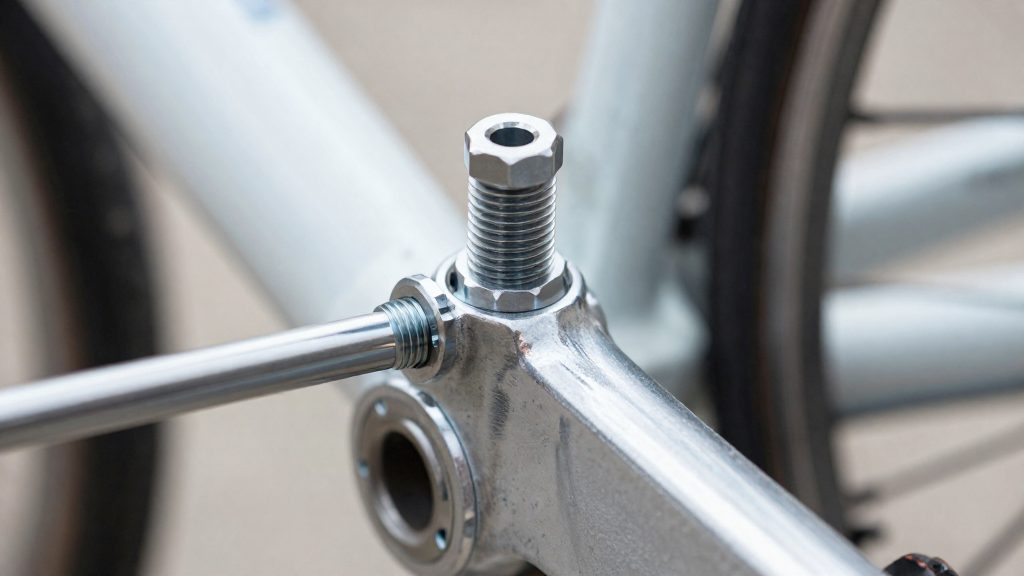
The barrel adjuster is the threaded fitting at the end of the cable housing. It changes cable tension without tools, which makes it the first adjustment to try when a stretched cable causes hesitant shifting. Work through the fix as a repeatable test cycle: make one small change, then verify it before changing anything else. Turning several steps at once hides the effect of each one, so you cannot tell which change helped.
Put the bike on a stand with the rear wheel off the ground and the chain on a middle cog. The barrel adjuster is a knurled, threaded cylinder on the rear cable housing, usually near the shifter or at the frame’s cable stop. Note the exact gear where shifting fails before you turn anything.
| Step | Action | Check |
|---|---|---|
| 1 | Shift to the gear that fails, one click at a time. | Record the gear and the direction that hesitates. |
| 2 | Turn the barrel adjuster a quarter-turn in the direction that matches the symptom. | Stop if the adjuster turns unevenly or resists. |
| 3 | Shift through every gear on the cassette, up and down. | Each shift should land in one click without hesitation or noise. |
| 4 | Repeat steps 2 and 3 only if the symptom remains. | Stop as soon as the symptom disappears. |
BikeRadar (2026-03-09) advises quarter-turn steps with a re-check after each one. Small steps keep any overshoot easy to reverse. Testing every gear, rather than only the failing one, matters because a tension change affects the whole range. A setting that cures the middle of the cassette can cause a new problem at the top or bottom.
If a few quarter-turns do not restore clean shifting, stop the cycle.
Which way should you turn it?
The rear barrel adjuster works in opposite directions depending on the symptom, so identify which way the chain is failing before you turn it. Turning counter-clockwise tightens the cable, and turning clockwise loosens it.
| Symptom | Barrel adjuster turn | Result |
|---|---|---|
| Rear chain won’t climb to the next larger cog, toward the spokes | Counter-clockwise | Adds cable tension |
| Rear chain overshifts past the intended cog | Clockwise | Releases cable tension |
| Front derailleur hesitates on an upshift | Half turn counter-clockwise | Adds cable tension |
For the rear derailleur, stand behind the bike so you can see the cassette and chain alignment from the rider’s position. South Shore Cyclery recommends testing the shift after each adjustment. Use the quarter-turn steps above, which are smaller and easier to reverse than the half-turn steps in its guide. If shifting hesitates when moving toward the spokes, turn counter-clockwise. If it hesitates when moving away from the spokes, turn clockwise. Test the shift under load, pedalling in the gear where the problem occurs, since a stretched cable often only shows its fault when the chain is under tension.
The front derailleur uses a different starting point. BikeRadar (2026-03-09) suggests a half turn anticlockwise on the front barrel adjuster when an upshift hesitates. That single move is the starting point. Test the front shift again before making any further change, so you can tell whether the cable tension was the cause.
When the barrel adjuster is not enough
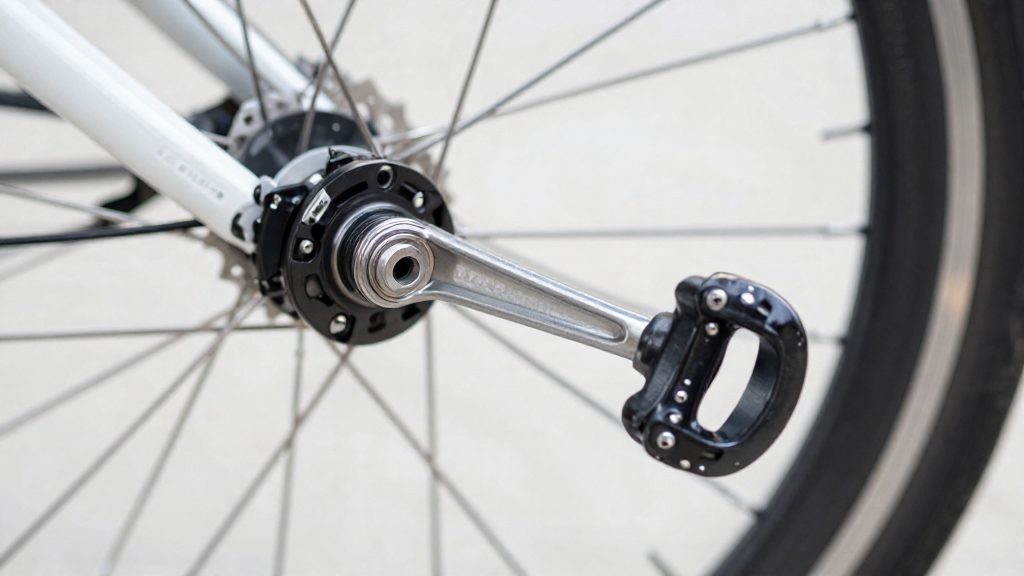
The barrel adjuster changes cable tension, but it cannot correct a derailleur that is positioned wrongly. Two setup values sit outside its reach: the B-gap and the limit screws. Both belong to derailleur setup, not to a cable-stretch fix. If shifting stays wrong after tension has been corrected, check the hanger, chain and cassette first, then the B-gap. The limit screws are a setup task, done with the cable disconnected and not part of a cable-stretch fix, so leave them to a shop.
The B-gap is the distance between the upper guide pulley and the cassette. On a rear derailleur, the typical B-gap is 5–6 mm measured to the largest cog, according to BikeRadar (2026-03-09). Set it with the B-screw on the derailleur body. A gap that is too large lets the chain hesitate to climb onto the larger cogs. A gap that is too small makes the pulley rub the cassette and can make the chain sound noisy or drag.
The limit screws stop the derailleur’s travel at each end of the cassette. The high-limit (H) screw stops it at the smallest cog, toward the frame. The low-limit (L) screw stops it at the largest cog, toward the spokes. Both are set with the cable disconnected, because the derailleur must be free to reach its stops without cable tension holding it. BikeRadar (2026-03-09) notes that poorly set limits can let the chain fall off the cassette or into the spokes.
A practical sequence for checking these settings:
| Check | Target | Purpose |
|---|---|---|
| B-gap | 5–6 mm to the largest cog | Clean chain climbing onto larger cogs |
| High limit | Chain stops at the largest cog | Prevents overshift toward the spokes |
| Low limit | Chain stops at the smallest cog | Prevents overshift toward the frame |
| Cable tension | Re-tested after limits are set | Confirms the adjuster is working in its range |
Set the limits first, then the B-gap, then reconnect the cable and retest every gear. Changing the B-gap moves the pulley’s relation to the cogs, so recheck the limits afterward.
If shifting still hesitates or the chain will not stay on the cassette after the limits, B-gap and tension are all correct, stop adjusting. Continued turning of the barrel adjuster in this state masks the real fault, and the bike should be inspected by a shop.
Check the hanger, chain and cassette
Before adjusting cable tension, confirm that the drivetrain is not causing the symptom. A bent derailleur hanger, a worn chain or a worn cassette can produce hesitant or noisy shifting that resembles a stretched cable, and cable adjustment cannot correct any of them.
Inspect the derailleur hanger
The derailleur hanger is the small tab at the rear dropout that carries the rear derailleur. It is the first part to check after a crash. According to BikeRadar (2026), a bent hanger can make the chain shift too far toward the spokes, and the hanger then needs straightening or replacing. To inspect it, remove the rear wheel, stand behind the bike and sight down the hanger to see whether the derailleur sits in line with the cassette. A visibly misaligned hanger must be corrected before any cable work is worthwhile.
Assess chain and cassette wear
Chain wear elongates the pitch between rollers, so the chain no longer seats correctly on the cassette teeth. Measure the chain with a chain wear indicator and compare the reading against the manufacturer’s stated wear limit. Then inspect the cassette: teeth that are hooked or shaped like shark fins indicate that the cassette is worn. A worn cassette will continue to skip on a new chain, so replace both together when the cassette shows that wear.
Identify spoke contact
Spoke contact is a separate fault. If shifting suddenly hesitates in harder gears, or the largest cog clicks, the derailleur may be hitting the spokes. South Shore Cyclery advises taking the bike to a shop in this case. Continued cable adjustment will not clear the contact.
| Symptom | Likely cause | First check |
|---|---|---|
| Chain skips under load on several cogs | Worn chain or cassette | Chain wear indicator; cassette tooth profile |
| Shifting toward the spokes is misaligned after a crash | Bent derailleur hanger | Sight line from behind the bike |
| Sudden hesitation in harder gears, or largest cog clicks | Derailleur contacting spokes | Stop adjusting; take to a shop |
When to replace cables and see a shop
Gear cables stretch with use. BikeRadar advises replacing gear cables about once a year (BikeRadar, 2026-03-09). Treat this as a baseline for regular riding. A bike that is ridden in wet or gritty conditions, or that is stored outdoors, benefits from earlier inspection, because grit and water speed up wear on the inner cable and housing.
A stretched cable is a wear item. The barrel adjuster compensates for slight stretch and restores clean shifting, but the cable keeps wearing. Replace it on schedule, or sooner if the adjuster runs out of range or the cable is frayed or the housing damaged.
Damage that calls for replacement regardless of age is different from normal stretch:
| Condition | Action | Where to do it |
|---|---|---|
| Cable stretched, shifting no longer clean | Replace the inner cable | Home or shop |
| Inner cable frayed or with broken strands | Replace the inner cable | Home or shop |
| Housing kinked, crushed, or split | Replace the outer housing and the inner cable | Home or shop |
| Cable rubbing the frame or catching in the routing | Re-route and tune in the workshop | Shop |
A frayed inner cable can snag inside the housing and then break under load, so it should be replaced rather than adjusted. A kinked housing restricts the cable’s movement and produces stiff or uneven shifting that no barrel adjustment will cure, so the housing section needs renewal.
Taking the bike to a shop makes sense when the cable route itself is the problem. Cable routing around the frame, through the handlebar, and along the chainstay or down tube affects friction and clearance, and a workshop can check that the route is correct and the housing lengths suit the frame. Workshop tuning after a cable change also confirms that the shifts are accurate across the full range of gears.
Frequently asked questions
How can I tell a stretched cable from a bent derailleur hanger?
Check the derailleur hanger first, especially after a crash, because a bent hanger can push the chain toward the spokes just as a stretched cable can. If shifting suddenly hesitates in the harder gears, or the largest cog clicks, the derailleur may be hitting the spokes, so take the bike to a shop.
Which way do I turn the rear barrel adjuster?
Turn it counter-clockwise when the chain will not climb to the larger cog nearer the spokes, and clockwise when it overshifts past the target. Work in quarter-turn steps and re-test after each one, so a turn that overcorrects is easy to reverse.
Should I adjust the limit screws to fix stretched-cable shifting?
No. The high-limit (H) screw stops the derailleur at the smallest cog, toward the frame, and the low-limit (L) screw stops it at the largest cog, toward the spokes. They are a setup task done with the cable disconnected, not part of a cable-stretch fix, so if shifting stays wrong after tension is corrected, check the hanger, chain and cassette first.